
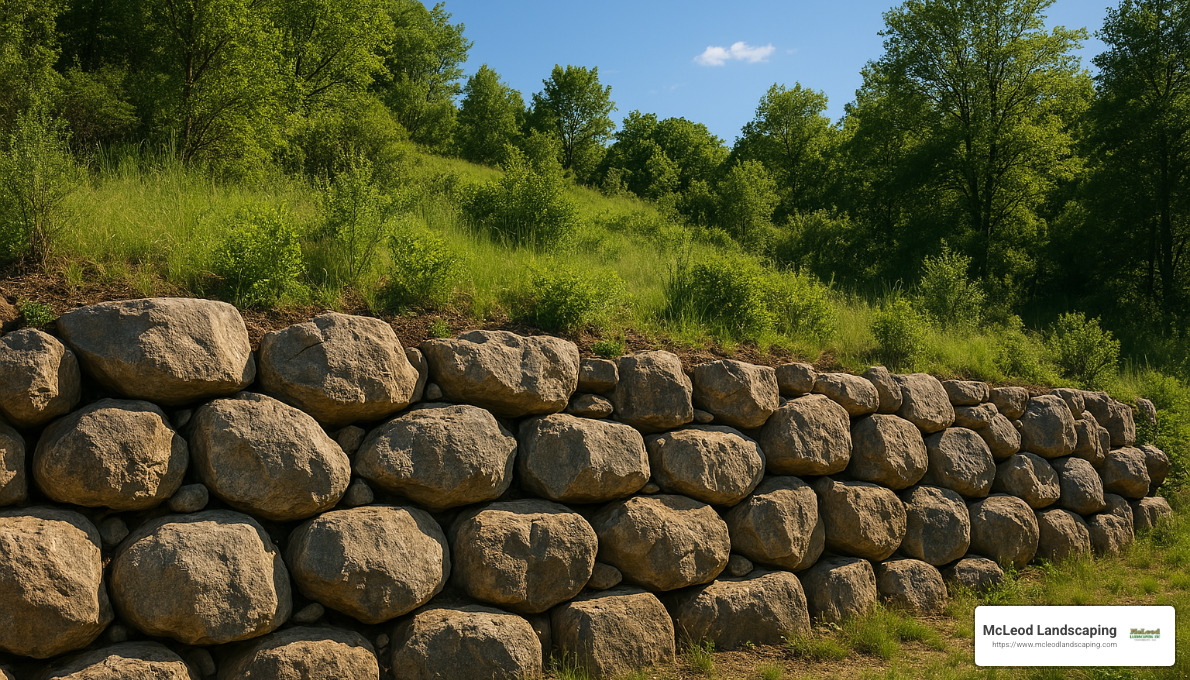
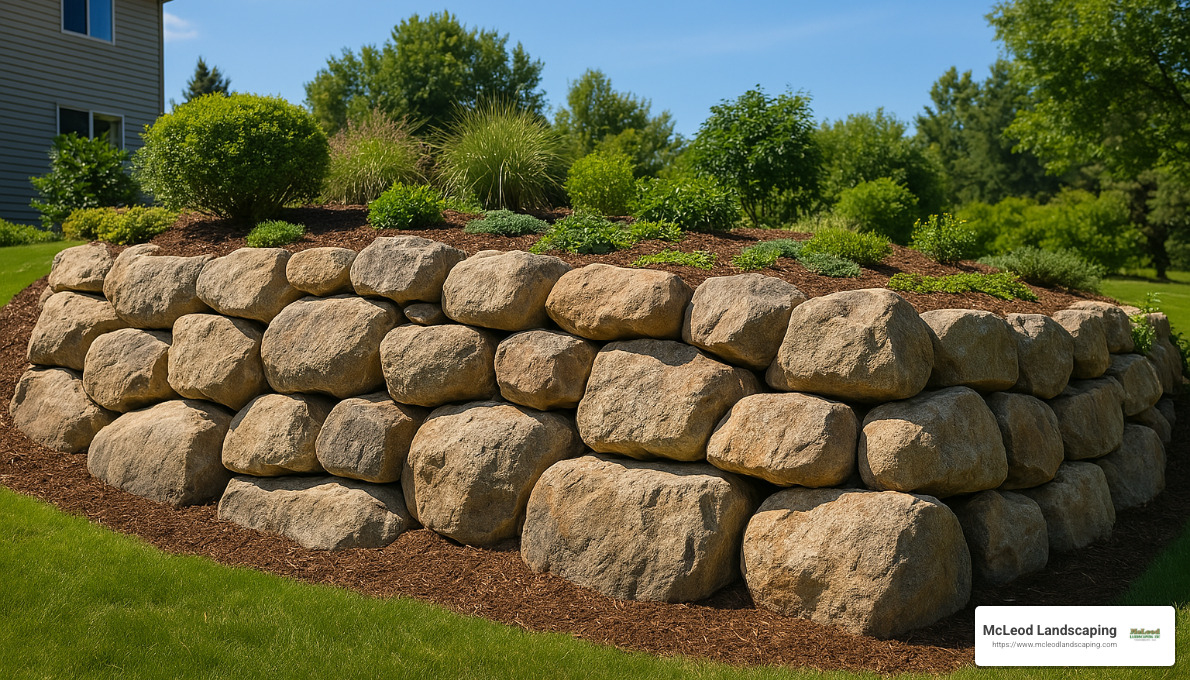
A boulder retaining wall is a structure made from large, natural stones stacked together to stabilize slopes, prevent erosion, and improve landscape aesthetics.
Quick key points about boulder retaining walls:
Boulder retaining walls aren’t just functional—they make landscapes look naturally beautiful, blending seamlessly with greenery and outdoor spaces.
I’m Scott McLeod, owner of McLeod Landscaping Inc., and I’ve spent more than 30 years helping residential and commercial clients build beautiful, long-lasting landscaping features, including boulder retaining walls. In this guide, I’ll walk you through exactly how to create a successful boulder retaining wall for your property.
For additional references about the geology and composition of natural stone, you may find this Stone (Wikipedia article) helpful.
Important boulder retaining wall terms:
– rock walls
– retaining wall drainage
– retaining wall design
When it comes to retaining walls, you have several options—concrete blocks, timber, gabion cages, and more. However, boulder retaining walls stand out for several compelling reasons that make them an excellent investment for your property.
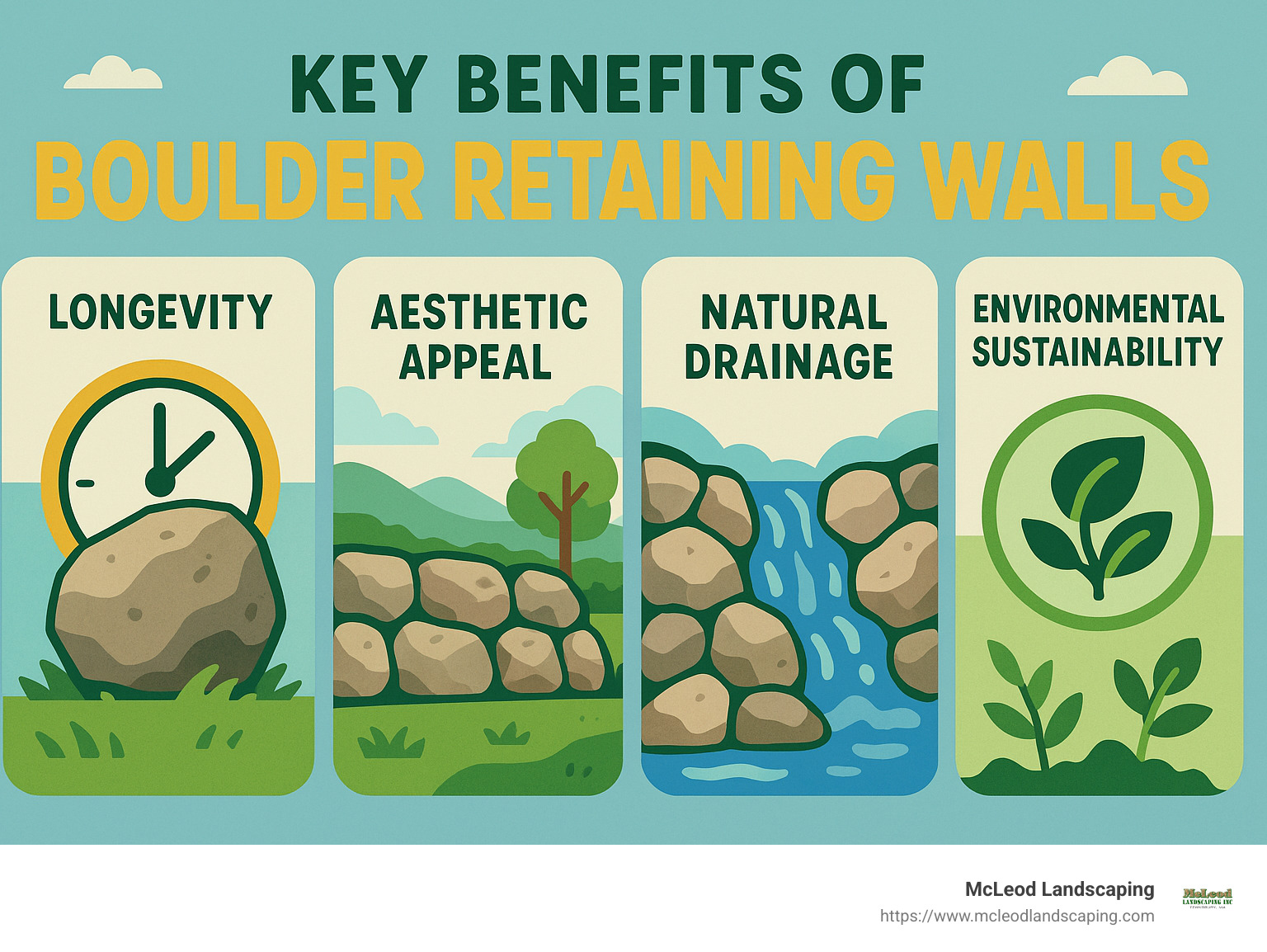
One of the primary benefits of using boulders for retaining walls is their exceptional durability. When properly installed, these walls can last anywhere from 50 to 200 years. As one landscaping expert notes, “Boulders typically endure weather and time without the degradation that affects other wall materials.”
Unlike manufactured materials that may crack, fade, or deteriorate over time, natural stone has already withstood centuries of geological processes. Boulders are naturally resistant to:
This inherent durability translates to minimal maintenance requirements over the lifetime of your wall.
Perhaps the most visually striking advantage of boulder retaining walls is their authentic, natural appearance. As part of the landscape itself, boulders create a seamless transition between built and natural environments.
“Boulders have an innate beauty and natural style which creates stunning retaining walls,” explains a stone masonry expert. This natural aesthetic allows your retaining wall to become not just a functional structure but a focal point in your landscape design.
The varied textures, colors, and shapes of natural stone create visual interest that manufactured materials simply cannot replicate. Whether you’re looking to create a rustic mountain retreat feel or complement a formal garden design, boulder walls can be customized to match your vision.
The substantial weight and interlocking nature of boulders make them exceptionally effective at controlling erosion on sloped properties. Their mass provides the stability needed to hold back soil and prevent washouts during heavy rains.
Beyond just holding soil in place, properly constructed boulder retaining walls offer natural drainage pathways. The irregular shapes and gaps between stones allow water to seep through rather than build up behind the wall, relieving hydrostatic pressure that can cause other types of retaining walls to fail.
Using natural stone for your retaining wall is an environmentally friendly choice. Unlike manufactured materials that require energy-intensive production processes, boulders are simply harvested and relocated.
Additional environmental benefits include:
As one landscape designer puts it, “Using boulders reduces environmental impact since no manufacturing is needed—only relocation of natural materials.”
For more information about designing the perfect retaining wall for your property, visit our Retaining Wall Design page.
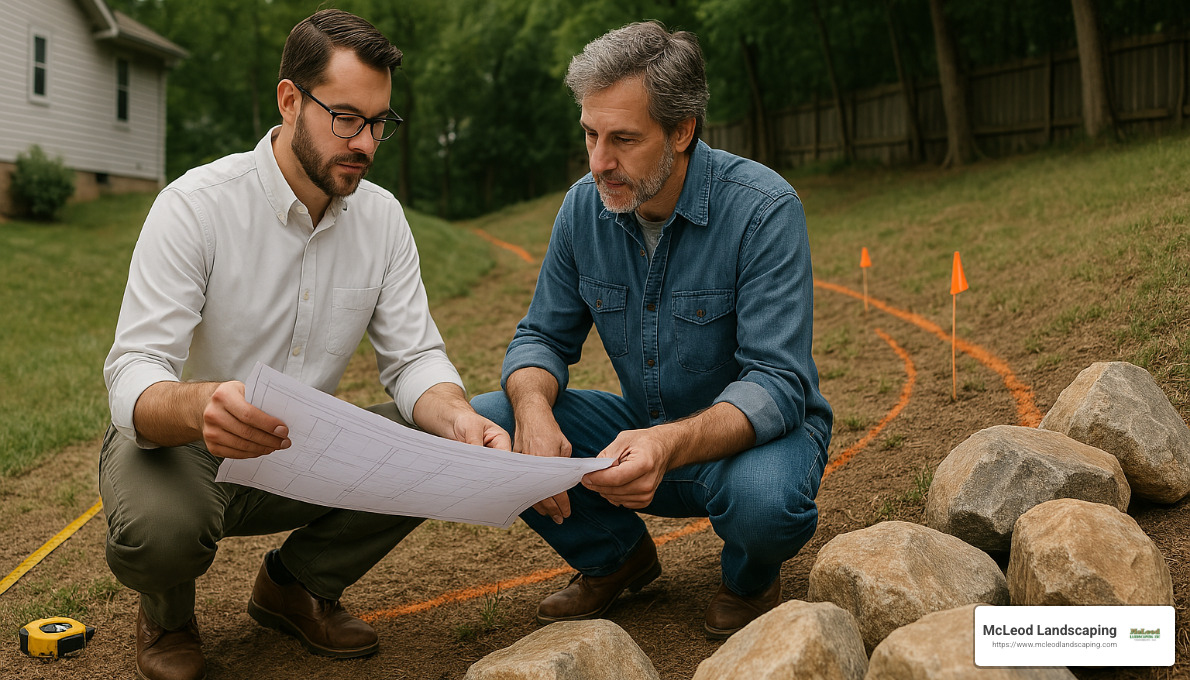
Planning your boulder retaining wall may not be as exciting as choosing beautiful stones—but trust me, it’s just as important. Good planning now means you’ll enjoy a strong, beautiful wall for decades to come, without headaches or surprises.
Before you can dig into construction (literally!), there are a few key steps to make sure your project goes smoothly: assessing your landscape, understanding local regulations, securing permits, and creating a clear, detailed plan. Let’s walk through each of these carefully.
Every boulder retaining wall should start with a thorough landscape evaluation. Grab a notebook and start looking at your property through the eyes of a landscape professional (or better yet, call one to help!). Here’s what you’ll need to keep in mind:
First, check the soil type on your property. Different soils have different quirks. Sandy soils drain quickly but can erode easily, so you’ll likely need a filter fabric behind the wall. Clay soils hold moisture and may need extra drainage systems to avoid pressure build-up. Rocky soils are sturdy but could make excavation more challenging. Knowing your soil will help determine your overall wall design—so don’t skip this step!
Next, notice the drainage patterns on your property. Take note of where water naturally runs during heavy rains, and pay attention to any spots that tend to puddle or wash away. Your boulder retaining wall should improve your property’s drainage, not worsen it. Good drainage solutions include drain pipes, gravel backfills, and filter fabric. (We have a whole guide on retaining wall drainage for extra help!)
Your terrain is also a big factor. How steep is your slope? Steeper slopes require taller walls or terracing. Also, consider existing erosion or natural rock formations that might be creatively integrated into your design. Don’t forget to look out for underground utilities that could create issues during excavation. (Better safe than sorry—call your local utility company to double-check!)
Lastly, you’ll need to consider the available space. Boulder walls involve large stones, heavy equipment, and room to maneuver them into place. Make sure there’s enough space for machinery to access your backyard and for the wall itself—including the necessary setback and surrounding landscaping. A good rule of thumb: If you find yourself thinking, “Wow, this is a tight squeeze,” it might be time to rethink your wall placement or size.
Here comes everyone’s favorite topic: permits and regulations. Okay, maybe not your favorite topic, but definitely a crucial one. Taking care of local regulations upfront saves time, money, and hassle in the long run.
Every municipality has its own local building codes regarding retaining walls. Usually, walls under 4 feet are straightforward, but if your wall height exceeds 4 feet, you’ll likely need permits and a professional engineer’s design. Codes often specify how close a wall can be built to property lines, require proper drainage systems, and outline inspection requirements.
Safety is always top priority. Walls that are tall, supporting heavy loads (like driveways or buildings), or built on steep slopes need professional engineering to ensure stability. Generally, building codes require that walls have a Factor of Safety greater than 1.5 for stability against sliding or overturning. This ensures your wall stays put, no matter what Mother Nature throws at it.
Speaking of engineering—if your project is complex or involves special considerations, hiring a structural engineer isn’t just smart; it’s essential. Engineers can provide detailed specifications for your foundation, drainage design, and wall construction methods. They can calculate exactly what dimensions and materials will work best, ensuring your project meets safety standards and local building requirements. Plus, having professional engineering plans can simplify the permit application process significantly.
As a wise landscaping pro once said, “A properly installed retaining wall is worth its weight in boulders.” (Okay, I admit—that landscaping pro was me.) But seriously, investing the time and effort now into careful planning and obtaining proper permits protects your investment in the long run.
By carefully assessing your landscape conditions, complying with local regulations, and consulting the right professionals, you’ll set your boulder retaining wall project up for success from the first stone to the last.
Now that we’ve got the planning covered, let’s dive into choosing materials—check out our next section where we’ll explore the best boulders to build your dream retaining wall!
Choosing the right materials is a crucial step in creating a durable, beautiful, and lasting boulder retaining wall. The stones you select will directly influence not only the look of your landscape but also the functionality and lifespan of your wall. Let’s look at the types of boulders that work best, how to calculate your material needs, and what you can expect in terms of costs.
When planning your boulder wall, you’ll typically encounter three main types of stones: fieldstone, quarry boulders, and river-washed rocks. Each has its unique charm, benefits, and practical considerations.
Fieldstone boulders are naturally occurring stones often collected from fields or agricultural areas. They have a weathered, rustic appearance, with softer textures and rounded edges. Because they’re typically locally sourced and plentiful, they’re often budget-friendly and blend seamlessly into natural settings. That said, their irregular shapes can require thoughtful planning to achieve a stable, secure fit. For homeowners aiming for a natural, rustic aesthetic, fieldstone is an excellent choice.
Quarry boulders are freshly harvested stone, cut and shaped directly from local quarries. These rocks tend to be more angular, giving you cleaner lines and more consistent shapes. That makes them easier to stack and arrange neatly. Initially, they might look a little less “natural” than fieldstone, but over time they weather beautifully, blending with the landscape. If you’re looking for a more structured or formal wall, quarry boulders are ideal.
Finally, river-washed boulders feature those gorgeous smooth surfaces and rounded edges, shaped by centuries of water flow. They’re beautiful and distinctive, perfect for creating an eye-catching design element. However, their curves and rounded shapes can make stacking and stabilizing a bit trickier. Often, these stones work best as accents or within walls combined with other more angular stones.
When considering which boulders to choose, it’s crucial to factor in your property’s unique conditions, including soil type, wall height, ease of access for equipment, and your overall design vision. As landscape architects frequently emphasize, matching your boulder choice to your landscape’s character and your personal style always yields the most harmonious and appealing result.
Once you’ve selected your boulder type, it’s time to determine how much material you’ll actually need. Accurate estimates help you budget correctly and ensure your project goes smoothly without costly delays.
First, calculate your wall’s surface area by multiplying the length by the height. But don’t stop there—your wall will need a solid base, with roughly 20-30% of the wall height buried beneath ground level. For example, if you’re building a 5-foot-tall wall, plan on an extra foot or so of height buried underground.
Another key measurement is the wall thickness, usually about half to two-thirds of your wall’s height. A taller, more heavy-duty wall needs greater thickness for stability. Don’t forget to add extra materials if your wall has curves, corners or special design elements.
For simplicity, you can use this basic formula:
Volume (in cubic feet) = Length × Height × Thickness
Because boulders don’t fit together perfectly—despite the best intentions—it’s wise to add around 15-20% extra volume to cover gaps and provide flexibility in placement.
Now, let’s talk about everyone’s least favorite—but very important—topic: cost. Like any landscaping project, boulder retaining wall prices can vary significantly. Factors influencing cost include your chosen stone type, wall size, labor rates, site conditions, and drainage requirements.
On average, internet data shows you can expect costs to range roughly from $40 to $55 per square foot for simpler walls. But more intricate or challenging installations—think taller walls, difficult terrain, premium materials, or extensive drainage solutions—can push costs significantly higher, sometimes reaching upwards of $200 per square foot.
When calculated per linear foot, the average range is around $50 to $200 per linear foot, with very complex installations potentially approaching $340 per linear foot.
These numbers aren’t exact quotes for McLeod Landscaping’s services, but general averages from internet sources to give you a ballpark idea.
While the upfront costs might seem steep, remember: a properly built boulder retaining wall can last anywhere from 50 to 200 years. That impressive lifespan means your initial investment spreads over decades of service, often making boulders more cost-effective over time compared to materials with shorter lifespans.
For more detailed guidance on your retaining wall project, explore our comprehensive Retaining Wall Design resource, or get in touch with McLeod Landscaping. We’ve proudly served the Merrimack Valley for over 30 years, helping homeowners and businesses create beautiful, lasting landscapes.
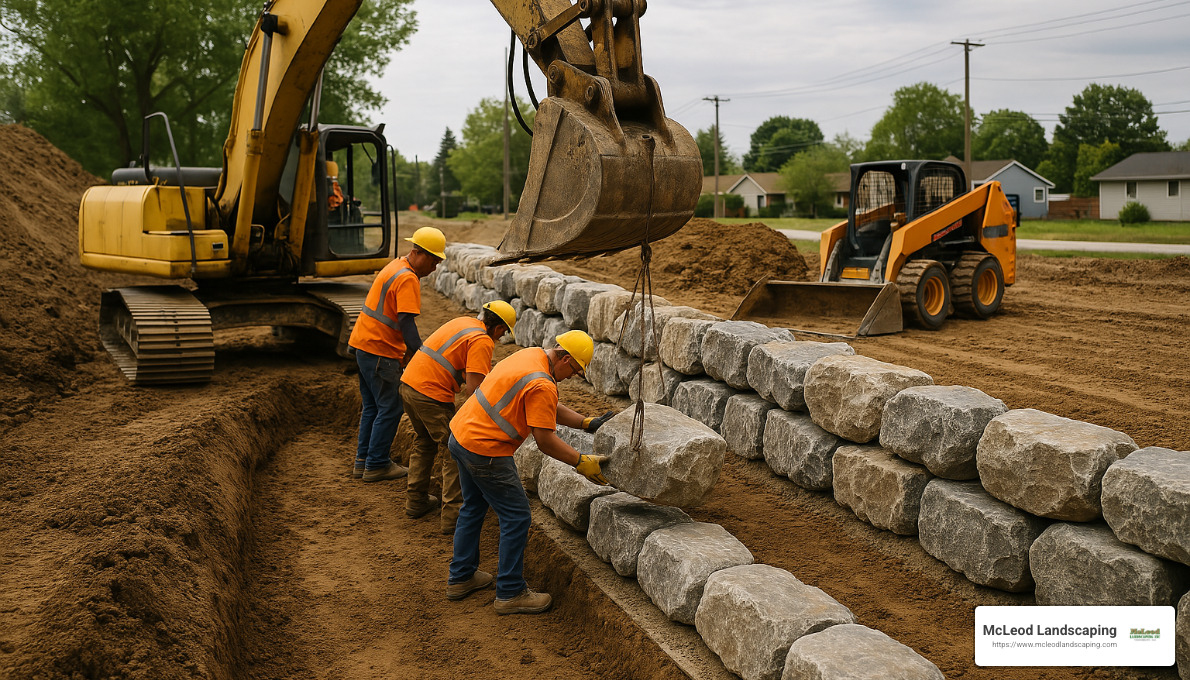
You’ve carefully planned your landscape, assessed your property, selected the perfect boulders, and obtained your permits—now comes the rewarding part: actually building your boulder retaining wall! Let’s walk through this process step by step, from laying a strong foundation to achieving a beautifully natural finish.
This process involves heavy lifting and machinery, so unless you have significant experience, you’ll likely want to bring in a professional landscaping company like McLeod Landscaping to ensure a safe, stable, and beautiful result.
Just like building a house, your boulder retaining wall needs a solid foundation to stand the test of time. Here’s how to set the stage for success:
Excavation is your first step. Begin by marking the exact location and dimensions of your wall using stakes and string lines. Start digging a trench about 6–8 inches below the ground level, wide enough for your largest boulders, plus extra room for stability and workspace. For taller walls (around 4 feet or higher), your trench should extend at least half the height of your wall into the slope behind it. A good rule of thumb from the pros: for a 4-foot wall, plan on a trench about 2 feet deep into your slope.
Next, create a sturdy gravel base. Add roughly 4–6 inches of crushed gravel into your trench, and compact thoroughly with a mechanical plate compactor. This gives you a stable, level surface to place your boulders, helping your wall stay put year after year. For sandy or loose soils, placing landscape fabric under the gravel can prevent erosion and soil shifting.
If you’re planning a tall wall (typically over 4 feet), consider a concrete footer to give extra support. This involves setting forms, adding reinforcing steel, and pouring concrete (usually about 8–12 inches thick). It’s a bit more work, but trust us—your future self will thank you when your wall remains absolutely rock-solid for decades.
Now for the fun (and challenging) part—placing the boulders themselves! This isn’t just stacking stones; it’s an art form requiring patience, creativity, and maybe even some heavy machinery.
Start by positioning your largest, flattest boulders at the base. Think of these big stones as your wall’s cornerstone—they’ll keep everything stable, grounded, and secure. Set each one so its longer side extends backward into the slope rather than sticking out. Wiggle each stone into place, making sure it’s firmly seated on the gravel base without any rocking or wobbling. If needed, use smaller stones or crushed gravel underneath for leveling.
As you build upwards, it’s crucial to create an interlocking pattern. Stagger each boulder so it overlaps the joints below—similar to how bricks are laid. Each stone should touch at least two others beneath it. This gives your wall unity and strength, so it acts like one solid structure instead of individual stones.
And don’t forget to build in a slight backward lean known as batter. Aim for roughly a 1-inch setback per vertical foot of height—so if your wall is 4 feet high, the top should lean about 4 inches toward the slope. This slight lean helps the wall naturally resist soil pressure behind it, significantly boosting its longevity and safety.
Unless you’re Superman, you’ll likely need some heavy equipment to place large boulders precisely. Skid-steers, excavators, or compact loaders with grapple attachments can give you the control and power you need. Experienced equipment operators can position even enormous boulders neatly and safely (without inadvertently creating a new driveway through your flower beds!). If you don’t have experience with heavy machinery, this is definitely a stage where hiring pros like McLeod Landscaping is worth every penny.
Drainage might seem like an afterthought, but it’s actually essential to your wall’s lifespan. Without proper drainage, trapped water can build up behind the wall, creating pressure that could eventually topple your beautiful creation.
The best way to prevent this is by installing a proper drainage system right from the start. Behind your wall, as you place your boulders, fill in the space with clean drainage gravel (usually about ¾-inch stone) at least 12 inches thick. At the base, run a perforated drainage pipe to carry water safely away from your wall. Wrap this pipe in landscape fabric to help prevent clogs and soil infiltration.
Speaking of fabric—using a good-quality filter fabric between your soil and drainage gravel can keep your drainage system running smoothly. It stops soil from washing into your gravel and blocking water flow, allowing moisture to escape freely through your wall.
When you backfill with gravel, do it gradually—adding layers about 4–6 inches thick and gently compacting each before adding more. You don’t want to use heavy machinery too close to the back of your wall here, or you might accidentally shift the boulders. Finish off with a layer of topsoil on the very surface to allow for landscaping.
With these steps carefully followed (and maybe a helping hand from experienced landscapers!), you’ll have a sturdy, stunning boulder retaining wall that not only protects your property but also improves its beauty for many years to come.
Building a successful boulder retaining wall is both an art and a science. When done correctly, your wall will stand tall, beautiful, and sturdy for decades to come. But as with any construction project involving heavy materials and machinery, there are important safety tips to keep in mind—along with a few maintenance pointers for long-term success. Let’s explore what you need to know:
When you’re working with big boulders and heavy equipment, safety simply can’t be an afterthought. Keeping your worksite safe is just as important as building a stable, attractive wall.
First and foremost, heavy machinery should only be operated by trained and experienced individuals. Boulder placement often requires specialized equipment like excavators or skid-steers, and inexperienced handling can lead to serious injuries. Always maintain clear communication between equipment operators and crew through hand signals, radio headsets, or a combination of both. And one golden rule you should never break: never stand beneath or close to a suspended load or directly behind moving equipment. Trust me—keeping everyone out of harm’s way makes the whole experience more enjoyable (and less nerve-wracking!).
Speaking of staying safe and comfortable, don’t underestimate the importance of proper protective gear. Hard hats, steel-toed boots, heavy-duty gloves, and eye protection should be standard attire for everyone on-site. Moving heavy stones around is not a flip-flop-friendly activity (no matter how tempting it might be on a hot day!).
When it comes to placing your boulders, secure placement is critical. Each stone should be thoroughly checked for stability to prevent accidental shifting or sliding. If a stone feels wobbly or uncertain, it’s better to take a bit of extra time shimming or repositioning it. Temporary bracing can also be a valuable tool in tricky spots. Patience and careful attention during placement can prevent costly—and painful—accidents later.
One of the best parts about building a boulder retaining wall is its low-maintenance nature. After all, Mother Nature created these stones to last a lifetime. That said, a little inspection and care now and then goes a long way toward ensuring your wall stays sturdy and attractive for generations.
Regular inspections—say, every season, or especially after severe weather—help you stay ahead of minor issues before they turn into major headaches. Keep an eye out for things like shifting boulders, signs of erosion, or pooling water around the base. If you notice something off, don’t hesitate to bring in an expert for professional assessment.
If your inspection reveals signs of erosion, addressing it quickly is key. Look for the cause—maybe water runoff or poor drainage—and tackle it directly. Adding extra drainage measures like gravel backfill or drainage pipes might be needed. One popular (and attractive!) solution is to introduce vegetation to stabilize the soil. As one landscape professional humorously advises, “Plant the heck out of that wall!” Roots from low-growing plants and ground covers can help bind the soil together and prevent further erosion, while also beautifying your wall.
However, keep an eye on the plants you choose. Deep-rooted trees or heavy shrubs planted too close to your wall can put unwanted pressure on the structure. Stick with shallow-rooted, drought-tolerant ground covers and native plants for the best results. These add charm, color, and stability without causing structural issues. (Plus, your retaining wall will thank you for not drowning it in excessive watering!)
At the end of the day, following these best practices and tips during construction, and investing in simple ongoing maintenance, will ensure your boulder retaining wall remains beautiful, functional, and worry-free for years to come.
For more expert advice or professional retaining wall installation, McLeod Landscaping is here to help! With over 30 years of experience serving residential, commercial, and municipal clients in the Merrimack Valley, we know how to make landscapes shine. Visit our retaining wall installation page to learn more!
A properly built boulder retaining wall is one of the most durable landscaping investments you can make. In fact, when done right, these walls typically last anywhere from 50 to 200 years—that’s right, your great-great-grandkids might still be enjoying it!
Several factors influence just how long your wall will endure. The most important is installation quality. A strong foundation, proper drainage systems, and careful placement of each boulder play a huge role in extending your wall’s lifespan.
The type of stone you choose also makes a difference. Durable stones like quarry or fieldstone typically resist weathering, frost, and erosion much better than softer materials. Of course, your local environment matters too—things like soil conditions, how much moisture your landscape sees, and freeze-thaw cycles can all impact durability.
Finally, a little bit of maintenance goes a long way. Don’t worry—boulder retaining walls generally require very little care. Just periodically check to make sure drainage systems are clear and promptly address any unusual shifting or erosion.
When built right, these walls practically take care of themselves. As one industry expert puts it, “Boulders are naturally designed to resist weather, erosion, and salt degradation.” In other words, Mother Nature already did most of the hard work for you.
A small boulder retaining wall—say, under 2 or 3 feet tall—might be manageable as a DIY project if you’re handy, patient, and good at puzzles. But for the majority of homeowners, a professional installation is strongly recommended. Here’s why it’s usually best to call in the pros:
When your wall exceeds 4 feet in height, local building codes generally require engineering plans and permits. This isn’t just red tape—it’s important for safety, stability, and longevity. Similarly, if your retaining wall supports a driveway, swimming pool, or any important structure, you’ll absolutely need professional engineering to handle the extra loads safely.
If your property has tricky site conditions like steep slopes, unstable soil, underground utilities, or poor drainage, a professional’s expertise will make the difference between a beautiful, safe wall and expensive repairs down the road. And let’s face it—working with large boulders is a seriously heavy lift. Most homeowners simply don’t have access to the heavy machinery required, let alone the training to operate it safely.
Attempting a complex installation yourself comes with risks including structural failure, drainage problems, injuries, or costly code violations. Many DIY walls end up falling short—not because homeowners lack effort, but simply because building a sturdy boulder wall properly is harder than it looks.
As one retaining wall specialist warns, “Many boulder walls fail prematurely because they weren’t built correctly—often by contractors who didn’t specialize in them.”
At McLeod Landscaping, we’ve spent over 30 years building boulder retaining walls for commercial, municipal, and residential clients across the Merrimack Valley. Our experienced team uses specialized equipment and proven techniques to ensure your wall is as durable and beautiful as possible. Trust us—your back (and your budget) will thank you later!
The price for a boulder retaining wall can vary significantly based on your specific project, but according to online sources, average costs typically range from $40 to $55 per square foot. However, more complex projects—especially those with difficult site access or premium materials—can jump to $120-$200 per square foot or even more.
It’s important to remember prices are heavily influenced by several factors. The size and complexity of your wall matter a lot—larger or more intricate designs naturally require more materials, labor, and planning. Likewise, the type and sourcing of boulders impacts cost significantly. If suitable, attractive stone is available locally, you’ll save money versus having to truck in specialty boulders from afar.
Other important factors include your site’s accessibility (challenging sites add labor and machinery expenses), soil conditions (poor soils may need additional excavation and foundation work), and the complexity of your wall’s drainage system. Additionally, if your wall requires professional engineering and permits, that’s another cost to factor into your budget.
To give you a better sense of what this means in real-world dollars, internet sources estimate that when calculated by linear foot (rather than square foot), average costs generally range from $50 to $200 per linear foot, though highly complex, engineered installations can even reach up to $340 per linear foot. Individual boulders usually cost between $100 and $350 per ton, although large, premium specimen stones might run up to $600 per ton.
While these numbers can initially seem steep, consider the exceptional durability and minimal maintenance of a well-built boulder wall. Over its lifetime, a boulder wall often provides significantly better value than cheaper, less-durable alternatives. Or, as one expert puts it, “When you factor in lifespan and minimal upkeep, boulder retaining walls often become surprisingly affordable.”
(Please note: These are average prices based on internet data, not actual quoted costs from McLeod Landscaping. For personalized pricing custom to your specific needs, please contact us directly—we’d love to help!)
Building a boulder retaining wall is more than stacking stones—it’s about blending strength, stability, and natural beauty into your landscape. Done right, these walls serve a practical purpose by preventing erosion and managing slopes, while also elevating your outdoor spaces into striking features you’ll enjoy for decades.
Throughout this guide, we’ve explored the key aspects of constructing a lasting boulder retaining wall, from the unique advantages of natural stone to careful planning, site evaluation, permits, and material selection. We’ve walked step-by-step through the construction process, sharing tips for a strong foundation, proper drainage, and best practices that ensure durability. We’ve highlighted the importance of safety during installation, minimal yet vital maintenance needs, and addressed common questions about longevity, costs, and whether professional installation is necessary.
Let’s face it—while building a boulder retaining wall might look simple at first glance, working with massive, heavy stones and ensuring a structurally sound outcome is no weekend DIY project for most homeowners. Hiring professionals doesn’t just mean less backache; it’s about peace of mind, knowing your wall will stand tall and strong through weather and time (and avoiding becoming the viral “DIY Wall Fail” video on YouTube).
At McLeod Landscaping, we’ve been changing outdoor spaces in the Merrimack Valley for more than 30 years. We’ve tackled tricky terrains from the rocky hills of Andover to the rolling slopes of Westford. Our skilled team doesn’t just build walls—we create outdoor masterpieces that blend beautifully with their surroundings. Whether you’re looking to tame a stubborn slope or add stunning curb appeal, we’ve got you covered from start to finish.
Thinking of adding a boulder retaining wall to your landscape? We invite you to explore our Retaining Wall Installation service. Our experts will walk you through every step—from custom design and planning to meticulous construction and finishing touches.
A professionally crafted boulder retaining wall isn’t just another landscaping feature—it’s an investment that provides lasting value, beauty, and peace of mind. Ready to bring your landscaping vision to life? Let’s get started.
Contact McLeod Landscaping today at (978) 640-0957 or click here to schedule a consultation for retaining wall installation. Let our experienced team design and install a functional and visually appealing retaining wall that enhances your landscape.


1881 Main St Unit 1, Tewksbury, MA 01876