
When it comes to enhancing your outdoor space, concrete stairs and walkways play a crucial role. These structures not only offer practical benefits but also contribute to the overall aesthetic appeal of your property.
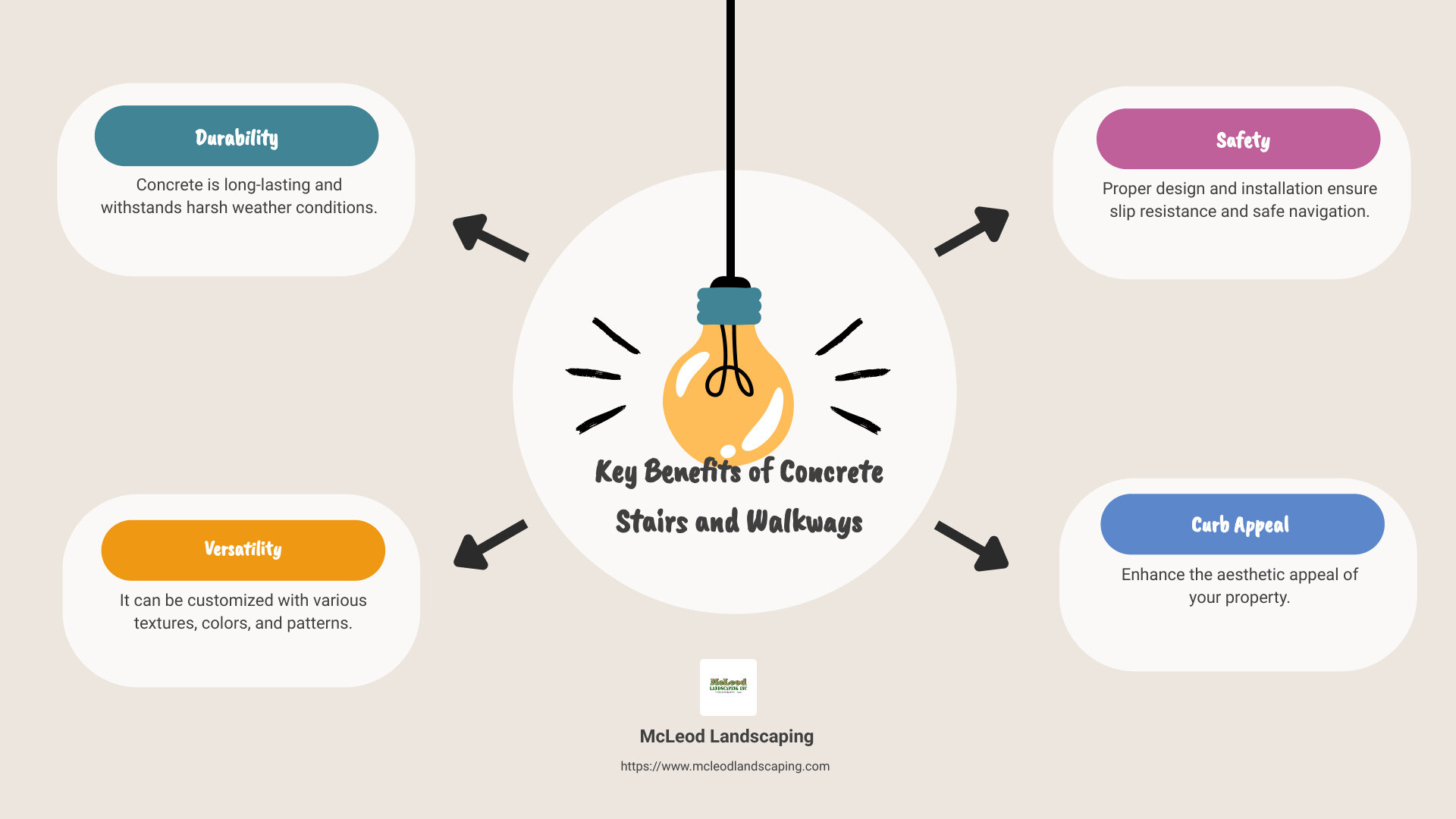
Whether you’re a homeowner aiming to boost curb appeal or a property manager ensuring safety and functionality, consider the following key points:
I’m Scott McLeod, owner of McLeod Landscaping. With over 30 years of experience in creating beautiful and functional concrete stairs and walkways, my team and I provide solutions custom to your specific needs. Let’s explore how you can transform your outdoor space with these structures.
Designing concrete stairs and walkways can be a fun and creative process. Here are some key elements to consider:
Adding color to your concrete stairs and walkways can make a big difference. You can use integral color, which mixes the color into the concrete before pouring, ensuring a consistent hue throughout. Staining is another option, offering a variety of rich tones. For a more durable finish, consider applying a dry-shake color hardener. This method involves spreading a colored powder onto the wet concrete surface, which then gets worked into the mix, providing a robust and vibrant finish.
“Concrete porch steps are often easier to color integrally because of their vertical step faces.” – Chris Sullivan, Vice President of Sales and Marketing for ChemSystems Inc.
Stamped concrete is a great way to add texture and interest. There are hundreds of patterns to choose from, including slate, brick, and cobblestone. Stamping mats, often molded from the actual materials they mimic, create realistic textures. Using thin flex mats or texture skins allows for seamless transitions from flat surfaces to steps, enhancing the overall aesthetic.
“By extending the pattern from sidewalk to stairway to landing, the overall effect is even more impressive.” – Expert Insight
Exposing the aggregate in your concrete can give a unique, textured look. This involves removing the top layer of concrete to reveal the small stones within. It’s a popular choice for those wanting a natural, earthy appearance. Exposed aggregate is also slip-resistant, making it a safe option for stairs and walkways.
If you love the look of natural stone but want the durability of concrete, you can replicate stone textures using stamping techniques. Patterns like granite, slate, and limestone can be imprinted onto the concrete surface, creating a high-end look without the high-end cost.
Edge forming can add a polished finish to your concrete stairs and walkways. Using specialized forms, you can create various edge profiles, such as bullnose or beveled edges. This not only improves the visual appeal but also adds to the safety by smoothing out sharp corners.
“Finishing up against the riser board forms was tricky. Any tips to get those areas? Timing is key. When you pull off those forms, leave just enough plasticity to rub the face with your magnesium float.” – Reddit User
By incorporating these design elements, you can create stunning and functional concrete stairs and walkways that improve the beauty and value of your outdoor space.
Next, let’s dig into the cost considerations for these projects.
When planning your concrete stairs and walkways, understanding the costs involved is crucial. Let’s break it down into several key areas: installation costs, DIY vs. professional, permits, and material choices.
Installation costs can vary widely based on the complexity and size of your project. On average, concrete walkways cost between $4 and $8 per square foot. For more elaborate designs, like stamped or stained concrete, expect to pay more.
Concrete stairs are generally more expensive due to the additional labor and materials involved. Custom concrete steps can range from $200 to $400 per step, depending on the design and finish.
Choosing between DIY and hiring a professional can significantly affect your budget. DIY might save money upfront, but it comes with risks. For instance, improper installation can lead to costly repairs down the line.
Hiring a professional ensures quality and durability. They can handle complex tasks like reinforcement and precise pouring techniques. According to Forbes, professional installation might save you money in the long run due to fewer mistakes and better materials.
In some areas, you may need a building permit for your project. Permits can cost anywhere from $100 to $1,000. These permits ensure that your project complies with local building codes. Always check with your local authorities before starting.
The materials you choose can also impact costs. Here’s a quick overview:
Choosing the right material is essential for balancing cost and aesthetics. For instance, McLeod Landscaping suggests that while concrete is affordable, flagstone offers a stunning natural look but at a higher price.
By understanding these cost factors, you can make informed decisions that fit your budget and design goals. Next, let’s dive into the installation essentials for concrete stairs and walkways.
Installing concrete stairs and walkways involves several crucial steps to ensure durability and safety. Let’s break down each part of the process.
Footings are the foundation of your concrete stairs and walkways. They provide stability and prevent shifting over time. For hillside installations, dig postholes as footings or piers to anchor the structure. This is especially important in areas with high shrink-swell soil, like Central Texas.
A well-prepared sub-base is key to a long-lasting installation. Start by excavating the area to the required depth, typically around 10 inches. Add a layer of compacted gravel or sand to provide a stable base. Compact the sub-base in 4-inch lifts to ensure it’s firm and level.
Reinforcement strengthens the concrete and prevents cracking. While wire mesh is an option, it can be challenging to bend into stair forms. Instead, use rebar. Place #4 rebar 12 inches from each side and one in the middle, then ladder them with 36-42 inch #4 bars at 12-inch intervals.
Pouring concrete requires careful planning and execution. Start from the bottom step and work your way up to prevent the concrete from flowing down. Use a low slump mix to ensure the concrete isn’t too wet. Your formwork should have boards for each riser but not the treads. This allows you to pour each step level to the tread before moving to the next.
Finishing touches add the final polish to your project. For a smooth look, use a magnesium float to cream up the surface of the risers. Timing is crucial; if the concrete is too dry, you won’t be able to fill any voids. Consider adding color or stamped patterns for a decorative finish. Stamping mats and texture skins can create realistic stone or brick patterns, enhancing the overall look.
By following these steps, you ensure that your concrete stairs and walkways are both beautiful and durable. Next, we’ll explore how to maintain and extend the life of your new installation.
Maintaining concrete stairs and walkways is key to their longevity and appearance. Here are some essential tips to keep them in top shape.
Sealing your concrete surfaces is crucial. A good sealant protects against moisture, stains, and wear.
Regular cleaning prevents buildup of dirt, mold, and stains.
Cracks and other damages can occur over time, but prompt repairs will prevent further issues.
Concrete can be affected by weather conditions, so taking steps to protect it is essential.
By following these maintenance tips, your concrete stairs and walkways will remain safe, functional, and attractive for years to come.
Next, we will look at the safety and compliance aspects to consider when installing concrete stairs and walkways.
When installing concrete stairs and walkways, safety and compliance with building codes are crucial. Here are key points to consider:
Research from Cornell University indicates that riser heights of 6 to 8 inches and tread depths of 10 to 13 inches are optimal for preventing tripping accidents. Treads narrower than 9 inches are particularly hazardous and should be avoided.
The absence of handrails is a significant cause of falls on stairways. Handrails should be continuous and installed at heights between 34 to 38 inches to accommodate most users, as stipulated by national and state building codes. Installing handrails can dramatically reduce the risk of falls and improve overall safety.
Proper lighting is essential for the safety of concrete stairs and walkways, especially at night. Use overhead lighting to ensure stairs are well-lit. Light fixtures inset into the step faces can also prevent dangerous stumbles after dark. Consistent light levels between stairways and surrounding areas help avoid sudden changes in visibility, reducing the risk of accidents.
Adding texture to the concrete treads is a simple yet effective way to make them slip-resistant. You can achieve this by using a textured finish, such as exposed aggregate, or by adding anti-slip grit to the protective sealer coat. This added texture provides better traction, especially in wet conditions.
By paying attention to these safety and compliance aspects, you can ensure that your concrete stairs and walkways are both safe and user-friendly.
Next, we’ll address some frequently asked questions about concrete stairs and walkways.
Generally, concrete stairs are more expensive upfront than wood stairs. Concrete steps can cost up to $300 per unit, while wood steps typically max out around $200 per unit. However, concrete stairs offer greater durability and lower maintenance costs over time. Wood stairs need regular upkeep, such as cleaning, staining, and sealing, which can add up. Concrete, on the other hand, is more durable and less likely to suffer from wear and tear, making it a cost-effective choice in the long run.
The cost of a set of concrete steps can vary widely based on several factors, including the size, design, and whether you opt for prefabricated or poured-in-place steps. On average, expect to pay between $200 to $300 per step. For a more accurate estimate, consider the specifics of your project:
Yes, concrete stairs typically require a foundation for stability and longevity. The foundation helps distribute the weight of the stairs and prevents shifting or settling over time. For prefabricated steps, a simple, stable base may suffice. However, for poured-in-place steps, a more robust foundation is often necessary. This could involve:
By understanding these foundational requirements, you can ensure your concrete stairs and walkways are built to last.
Changing your outdoor space with concrete stairs and walkways is a fantastic way to improve both the beauty and functionality of your property. At McLeod Landscaping, we specialize in bringing your vision to life with expert design and precise installation.
Whether you’re looking to add curb appeal with a stunning walkway or need safe, durable stairs for your backyard, our team has the experience and skills to deliver exceptional results. We use high-quality materials and proven techniques to ensure your project stands the test of time.
Well-designed concrete stairs and walkways not only improve the aesthetics of your home but also add value and safety. From choosing the right color schemes and patterns to ensuring proper footings and reinforcement, we handle every detail with care.
Ready to lift your outdoor space? Contact us today to schedule a consultation and find how McLeod Landscaping can transform your property into a stunning and functional oasis. Let’s create something beautiful together!
Contact McLeod Landscaping today at (978) 640-0957 or click here to schedule a consultation for retaining wall installation. Let our experienced team design and install a functional and visually appealing retaining wall that enhances your landscape.


1881 Main St Unit 1, Tewksbury, MA 01876