
Installing patio pavers is a rewarding home improvement project that adds value, creates a durable outdoor living space, and requires less maintenance than concrete or wood decking.
Quick Overview: The 7-Step Process for Installing Patio Pavers
Key Success Factors:
As Scott McLeod, with three decades of experience at McLeod Landscaping, I can confirm that installing patio pavers correctly prevents years of headaches. The secret to a lasting patio isn’t just placing stones—it’s building a solid foundation that can weather the New England climate.
Installing patio pavers word guide:
Before you start installing patio pavers, the planning phase sets the stage for a successful project. Think of this as the blueprint for your outdoor space.

Site selection is your first decision. Consider sun exposure and how the natural slope of your property will affect drainage—water must always flow away from your home’s foundation.
Next, create a realistic budget for materials and tool rentals. A plate compactor is a worthwhile rental expense that prevents future patio failures. When budgeting for a professionally installed patio, it’s helpful to understand potential costs. Based on general data from various online sources, the average cost for paver patio installation can range widely, typically from $18 to over $60 per square foot. This significant range depends on factors like paver material choice, site accessibility, project complexity, and regional labor rates. Please note, these figures are broad industry averages for informational purposes and do not represent the specific pricing of McLeod Landscaping. For an accurate quote tailored to your unique project, a direct consultation is always best.
Remember to check local codes and permit requirements. Some municipalities have rules about patio size and placement. A quick call to your local building department can prevent costly mistakes.
Most importantly, call 811 before you dig. This free service marks underground utility lines, preventing a dangerous and expensive accident. In Massachusetts, it’s the law.
If you need help with the design, our hardscape design services can create a detailed plan that accounts for drainage, materials, and your budget.
Having the right equipment makes installing patio pavers much smoother. Here are the non-negotiable items:
For materials, you will need:
Accurate calculations prevent extra trips to the supply yard. First, determine your patio square footage (length x width). For irregular shapes, break them into smaller rectangles and add them together.
To mark the layout, drive stakes at the corners and run a string line. Use the 3-4-5 triangle method to ensure square corners: a 3-foot measurement on one side and a 4-foot measurement on the perpendicular side should result in a 5-foot diagonal.
Establishing a slope for drainage is critical. Your patio must slope away from your house at a minimum of ¼ inch per foot. Mark this slope on your stakes and adjust the string lines accordingly.
Need design inspiration? Browse our backyard patio design ideas to see how proper planning creates stunning results.
The pattern you choose affects both aesthetics and structural strength.
Border pavers in a contrasting color or size give your patio a polished, finished look. For more inspiration, explore our collection of massachusetts outdoor living 20 inspirational patio design ideas.
Now it’s time to turn your design into reality. Installing patio pavers is methodical work where each step builds on the last. If the project feels overwhelming, our team offers comprehensive hardscape installation services to handle everything for you.
Precision during excavation is key to a long-lasting patio.
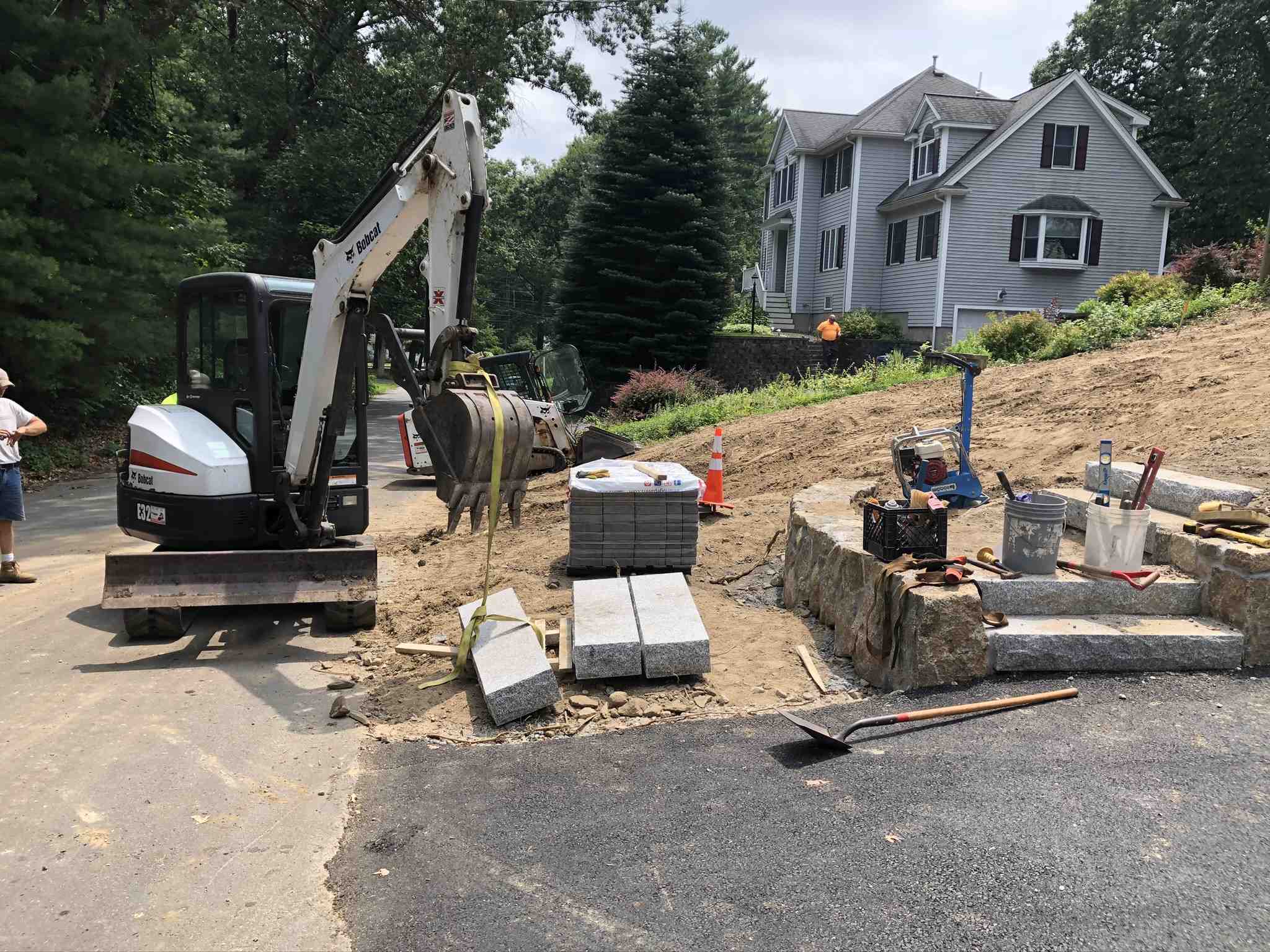
First, clear all grass, topsoil, roots, and rocks from the marked area down to undisturbed subgrade soil. Any organic material left behind will decompose and cause settling.
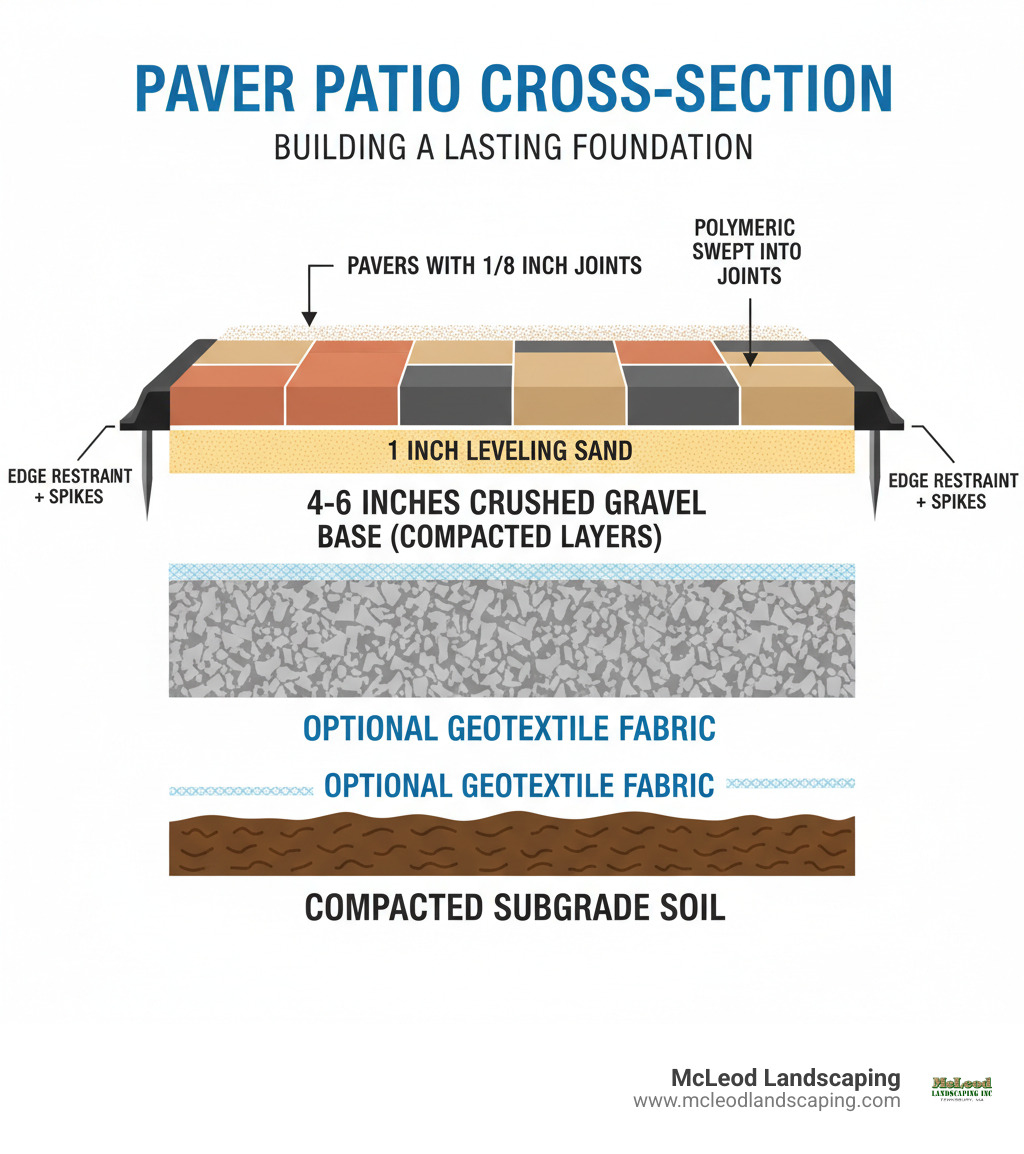
Excavation depth is critical. For patios and walkways, dig down 7-8 inches. This allows for 2 ⅜-inch pavers, a 1-inch sand layer, and a 4-6 inch compacted gravel base. For driveways, excavate 10-12 inches for a thicker 6-8 inch base.
As you dig, continuously check that you are maintaining the proper drainage slope (¼ inch per foot away from your home). Improper drainage is the #1 cause of paver patio failure.
Once at the correct depth, thoroughly compact the exposed soil with a plate compactor. This creates a firm foundation. If you have clay soil, lay geotextile fabric now to stabilize the base.
The gravel base is your patio’s foundation. Do not cut corners here.
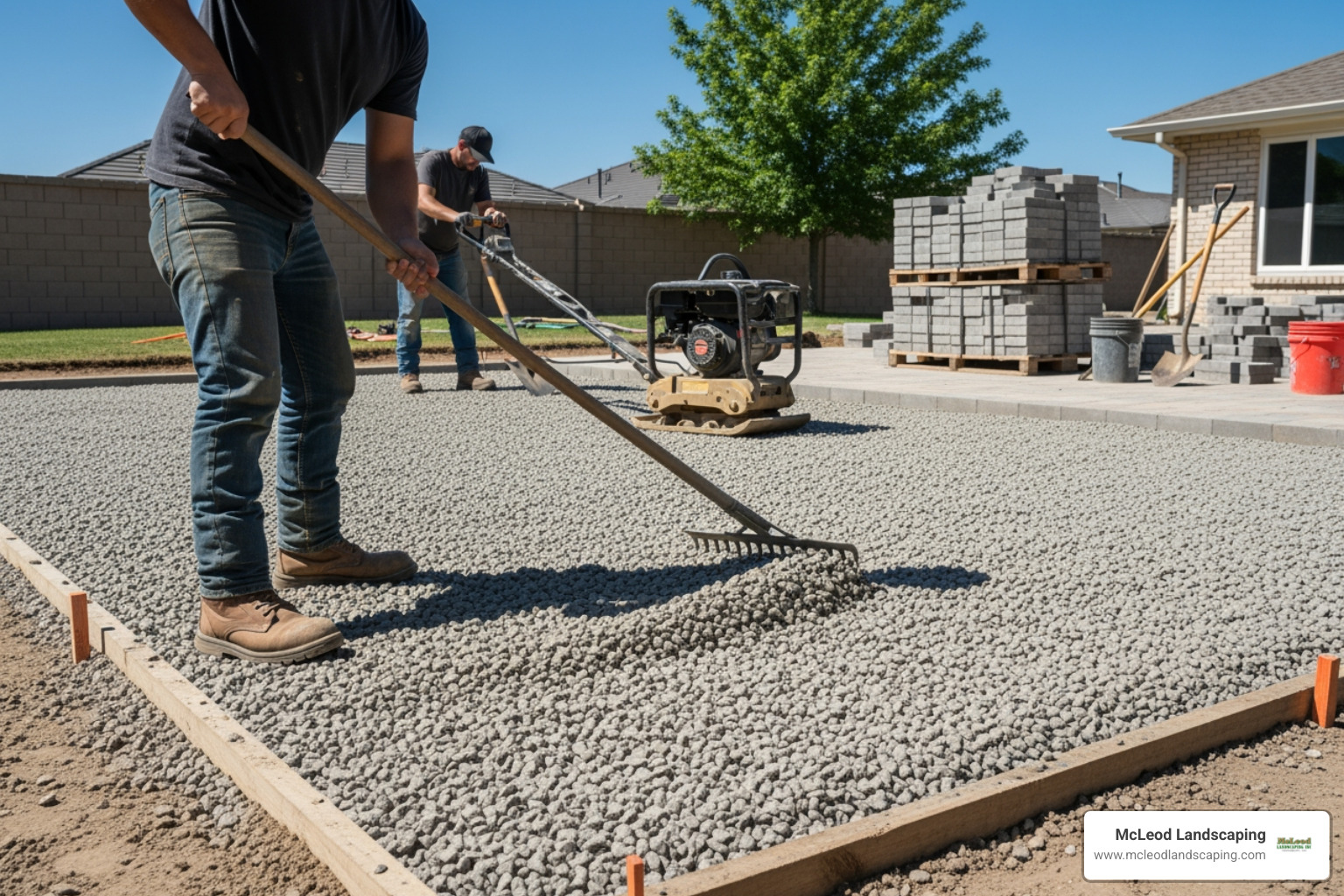
Spread your crushed gravel in lifts (layers) no thicker than 3 inches at a time. Compacting the full 4-6 inches at once is ineffective and leaves the bottom loose. Lightly misting the gravel with water helps it compact more densely.
After spreading each lift, make multiple passes with your plate compactor. Check for evenness and proper slope with a long level between each lift, correcting any grade issues as you go. Our base preparation methods follow ICPI guidelines, the industry gold standard.
This step creates a perfectly smooth, 1-inch bed for your pavers.
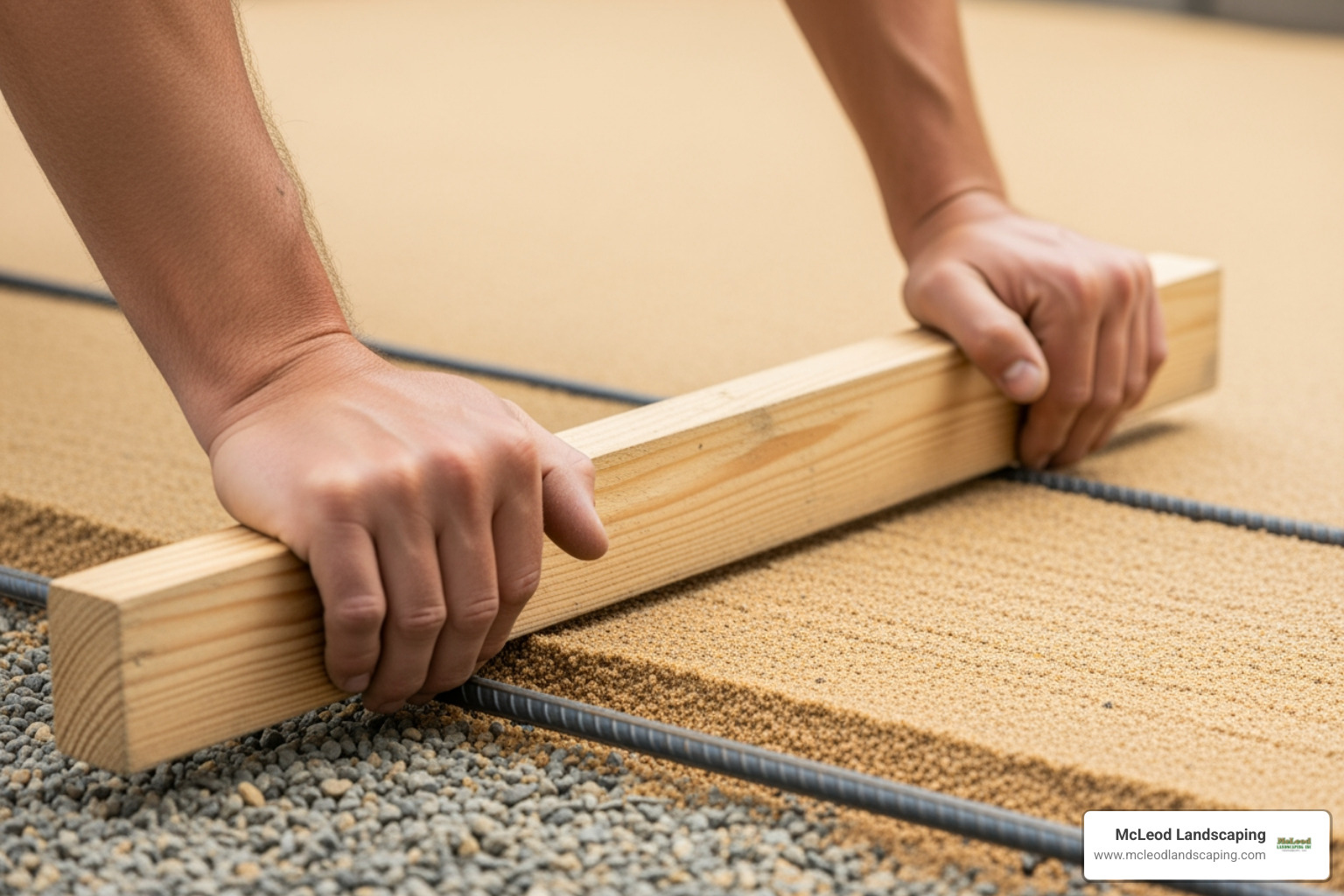
First, lay two 1-inch diameter PVC pipes parallel across your gravel base as screed guides. Pour your coarse bedding sand between them, then pull a straight 2×4 board across the pipes in a sawing motion to scrape off the excess, leaving a perfectly smooth surface.
Work in sections, removing the pipes and carefully filling the trenches with sand as you go. Crucially, do not compact this sand layer. The pavers need to be set into this loose sand, which will lock into place during the final compaction phase.
This is where your patio takes shape. Work methodically for the best results.
Start from a 90-degree corner or a straight edge, like the foundation of your house. This provides a stable reference point.
Place each paver straight down onto the sand; do not slide them. This preserves the smooth sand bed. Aim for a consistent ⅛-inch joint spacing. Most modern pavers have built-in spacer bars to make this easier.
Use string lines to ensure your rows remain straight. If a paver is slightly high, tap it with a rubber mallet. If it’s too low, lift it and add a small amount of sand underneath. Lay all full pavers first, saving the edge cuts for last. For professional results, consider our concrete pavers installation services.
Nearly every patio requires cuts for a finished look along the edges or around obstacles.

After laying all full pavers, measure and mark each cut individually with a pencil. A wet-cut masonry saw provides the cleanest cuts and controls dust. An angle grinder with a diamond blade can also work for smaller or curved cuts.
Safety is non-negotiable. Always wear eye protection, a dust mask (to protect from silica dust), hearing protection, and heavy gloves. Set up your saw on a stable surface and take your time. A clean, safe cut is worth the extra moment of care.
With your pavers laid, it’s time to lock everything into place for long-term stability. These final steps are what separate a professional patio from one that fails prematurely. For future upkeep, our hardscape maintenance service is always available.
Edge restraints are the invisible frame that prevents pavers from spreading apart due to foot traffic and New England’s freeze-thaw cycles. Do not skip this step.
Plastic or metal edging is common for residential patios. Secure it against the pavers with long landscape spikes driven into the gravel base. The top of the edging should sit at the base of the pavers so it can be hidden by soil or mulch.
For maximum stability, a concrete toe (or haunching) can be used. This involves pouring a concrete border along the outside edge of the pavers, creating an immovable frame. For projects involving larger structures, our retaining wall installation services can integrate seamlessly with your patio.
This step transforms individual stones into a unified, interlocking surface.
We exclusively use polymeric sand, which contains polymers that harden when wet. This locks pavers together, prevents weeds, and deters ants. Follow these steps for a perfect finish:
A correctly installed paver patio requires minimal upkeep.
A fire pit is a fantastic addition, but safety is paramount.
For a professionally built feature, consider our custom fire pit installation services to ensure your fire pit is both beautiful and safe.
Proper drainage is essential for a long-lasting patio. We achieve this through three key methods:
For properties with strict runoff rules, permeable pavers are an excellent solution that allows water to filter directly into the ground.
While “no-dig” methods exist for light-use paths on stable, level ground, they are not recommended for patios, especially in New England. These methods use a much thinner base (1-2 inches) that is highly susceptible to heaving during our freeze-thaw cycles. This leads to an uneven, unstable surface within a few seasons. For a patio that will last for decades, the traditional excavated base method is the only reliable approach.
After three decades of installing patio pavers, we’ve seen that most mistakes are avoidable. The most common errors include:
You now have the blueprint for installing patio pavers that will last. A successful installation depends on two key factors: a rock-solid, compacted base and proper drainage. While these steps aren’t glamorous, they are what separate a lasting patio from a future headache.
This is a labor-intensive project that requires physical work and precision. However, the satisfaction of building a beautiful, functional space with your own hands is immense.
That said, there’s no shame in calling in the professionals. Many DIY projects end in frustration when the realities of the physical demand and technical precision set in. Sometimes, the smartest move is recognizing when to hire an expert.
If you’re in the Merrimack Valley and would rather enjoy your new patio than spend weekends building it, our team of experienced patio installers is ready to help. We bring the right equipment, an expert eye for grading, and the efficiency that comes from decades of experience.
Whether you envision a simple space for morning coffee or an elaborate custom patio build with integrated features, we can bring your vision to life. Contact McLeod Landscaping today, and let’s start planning your perfect outdoor living space.
Contact McLeod Landscaping today at (978) 640-0957 or click here to schedule a consultation for retaining wall installation. Let our experienced team design and install a functional and visually appealing retaining wall that enhances your landscape.


1881 Main St Unit 1, Tewksbury, MA 01876