
Softscaping refers to all the living elements in your landscape design, including trees, shrubs, flowers, grass, groundcovers, and other plant materials that bring your outdoor spaces to life.
What is Softscaping?
- Definition: The living, horticultural components of landscape design
- Elements: Trees, shrubs, flowers, grass, groundcovers, mulch
- Characteristics: Changes seasonally, requires ongoing maintenance, adds color and texture
- Benefits: Improves air quality, reduces noise, lowers ambient temperatures by 7-14°F, can cut energy costs by up to 25%
- Contrast to Hardscaping: While hardscaping involves permanent structures like patios and walls, softscaping provides the evolving, living aspects of your landscape
When thoughtfully designed, softscaping does far more than simply fill in spaces around your hardscape features. It creates ambiance, absorbs noise, regulates temperature, and reflects your property’s unique character. Unlike the permanent nature of hardscape elements, softscaping evolves with the seasons, offering an ever-changing display of colors, textures, and shapes that breathe life into your outdoor environment.
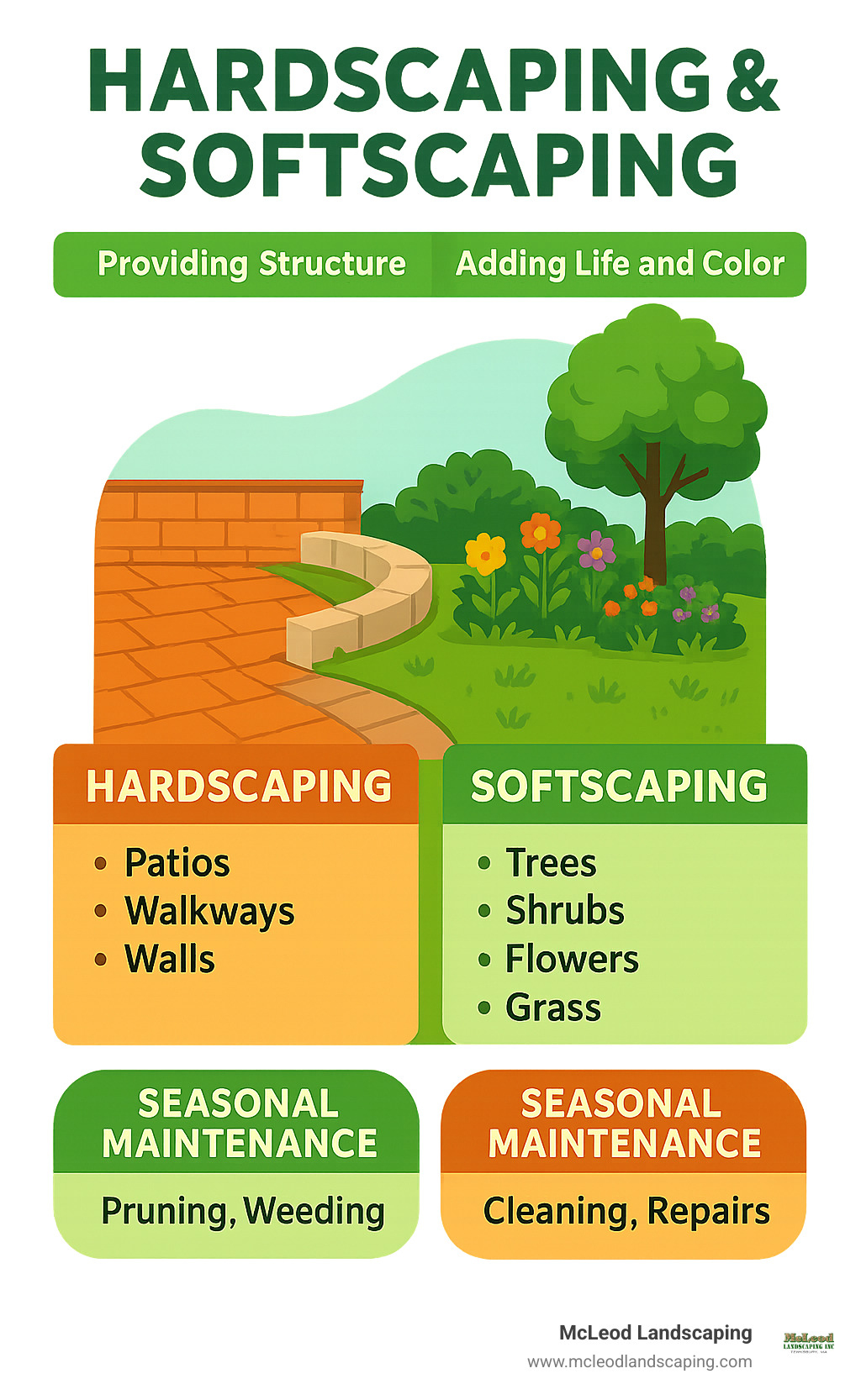
A well-balanced landscape integrates both hardscaping and softscaping elements, with each complementing the other. While hardscape provides structure and functionality through patios, walkways, and retaining walls, softscape adds warmth, movement, and sensory appeal that makes your outdoor spaces truly inviting.
I’m Scott McLeod, owner of McLeod Landscaping, and with over 30 years of experience creating and maintaining softscaping elements throughout the Merrimack Valley, I’ve seen how proper softscaping transforms properties from bland to beautiful.
Quick softscaping terms:
– hardscaping vs softscaping
– hardscape and landscape
– landscape and hardscape design
Imagine your landscape as a beautiful symphony. If hardscaping provides the rhythm and structure, softscaping delivers the melody, harmony, and soul that brings everything to life.
Softscaping includes all the living, breathing elements of your landscape design—those magnificent trees that shield you from summer heat, the privacy-providing shrubs that create your outdoor sanctuary, the faithful perennials that return with stunning blooms year after year, and that inviting carpet of green lawn where memories are made.
One of our Chelmsford clients put it perfectly after their landscape change: “Our new patio and walls give us wonderful places to gather, but it’s the plants and gardens that actually draw us outside in the first place.”
The relationship between hardscaping and softscaping is truly complementary, with each playing a distinct role in creating your outdoor haven:
| Feature | Softscaping | Hardscaping |
|---|---|---|
| Materials | Living: plants, soil, mulch | Non-living: stone, concrete, wood |
| Permanence | Changes with seasons and growth | Relatively permanent structures |
| Maintenance | Regular (watering, pruning, fertilizing) | Occasional (cleaning, sealing) |
| Purpose | Beauty, shade, privacy, habitat | Function, structure, access |
| Sensory Impact | Fragrance, texture, color changes | Visual weight, temperature, sound |
| Installation | Seasonal planting windows | Weather-dependent construction |
| Evolution | Grows and matures over time | Remains largely unchanged |
| Water Interaction | Absorbs, filters, uses water | Redirects, channels water |
While your hardscape elements establish the framework of your outdoor spaces, softscaping brings them to life. There’s something magical about the gentle swaying of ornamental grasses, the sweet perfume of flowering shrubs, and the cool respite beneath mature trees that creates an emotional connection to your landscape.
The living components of softscaping also offer practical benefits that hardscaping alone cannot provide. Plants naturally control erosion by stabilizing soil with their root systems, absorb rainfall to reduce runoff, and create natural cooling through transpiration—all while enhancing your property’s beauty and value.
For a deeper understanding of how these elements work together, check out our comprehensive guide on Hardscaping vs Softscaping.
In today’s concrete-dominated world, the living elements in our landscapes work harder than ever. Softscaping isn’t just pretty—it’s performing critical ecological functions that benefit both your property and our shared environment.
Research from the University of Minnesota has shown that lawns and planted areas can cool surrounding air temperatures by an impressive 7-14°F through natural evapotranspiration. For New England homeowners, this translates to tangible energy savings—properly placed trees and shrubs can reduce air conditioning needs by up to 25%, a welcome relief during those humid summer months in the Merrimack Valley.
Beyond keeping things cool, thoughtful softscaping creates micro-environments that support local wildlife. We recently completed a native plant garden for an Andover family who shared: “We’ve counted more butterflies and songbirds in the past month than we saw in five years with our old landscape. It’s like our yard has come alive!”
The environmental benefits extend underground too. When heavy New England rains fall or snow melts, softscaping serves as your property’s natural defense system. Living plants slow water movement, improve soil absorption, and filter out pollutants before they reach our local waterways. This storm-water management function has become increasingly important as development increases throughout our region.
The wellness aspect of softscaping deserves special attention. Scientific research consistently confirms what we intuitively know—spending time surrounded by plants reduces stress, lifts mood, and improves focus. Our commercial clients in Burlington and Billerica report more productive employees and happier customers in well-planted spaces, while our residential clients throughout the Merrimack Valley tell us they’re spending more family time outdoors after their softscaping improvements.
For scientific research backing these benefits, the University of Minnesota’s guide on the environmental benefits of lawns provides fascinating insights into how even simple turf areas contribute to environmental health when properly maintained.
Creating effective softscaping requires understanding the various living components available and how they work together in a cohesive design. Here are the fundamental elements we consider when developing softscape plans for our clients:
Everything begins with soil. Without healthy soil, even the most carefully selected plants will struggle. We assess soil structure, organic content, drainage, and pH levels before recommending specific plant materials. In many cases, especially in new construction sites around Tewksbury and Wilmington, soil amendment is a critical first step in establishing successful softscaping.
Think of soil as the silent partner in your landscape – you don’t see it, but it’s doing all the heavy lifting behind the scenes. Just like you wouldn’t build a house on a weak foundation, we won’t plant your garden in poor soil. It’s that simple, but often overlooked.
Trees form the backbone of your softscape design, providing structure, shade, and vertical interest. They’re the most permanent plant selections you’ll make, potentially outliving the human occupants of the property.
“When you plant a tree, you’re planting hope for the future,” as one of our Andover clients put it after we installed a small orchard on their property. Whether it’s a stately oak that will stand for generations or a flowering cherry that brings spring joy, trees set the stage for everything else in your landscape.
Shrubs create the mid-level structure in your landscape, defining spaces and providing year-round interest through foliage, flowers, and sometimes berries or interesting bark. From flowering hydrangeas that thrive in Concord’s partial shade to sturdy junipers that withstand Lowell’s urban conditions, shrubs are versatile softscape workhorses.
I often tell clients that if trees are the “ceiling” of your outdoor room, shrubs are the “walls” – they create definition, privacy, and that cozy feeling of enclosure that makes outdoor spaces feel like an extension of your home.
These plants return year after year, often expanding their footprint over time. From spring bulbs to summer bloomers to fall standouts, perennials provide changing seasonal interest with minimal replacement costs.
One of our Chelmsford clients laughs about how her perennial garden has become a neighborhood calendar: “When my peonies bloom, everyone knows it’s Memorial Day weekend. When the black-eyed Susans take over, it’s definitely August.” That’s the beauty of perennials – they mark time in a delightful, predictable way.
While requiring yearly replacement, annuals deliver the best color intensity and variety. They’re perfect for high-visibility areas where maximum impact is desired. Many of our commercial clients in Chelmsford and Burlington opt for seasonal annual rotations to keep their properties looking fresh and vibrant year-round.
Think of annuals as the jewelry of your landscape – they might not be the backbone, but they sure do make everything else look better with their bright, cheerful presence.
These low-growing plants spread to create living mulch, preventing erosion and weed growth while adding texture and sometimes flowers. They’re particularly valuable on slopes or in areas where mowing is difficult.
Groundcovers are the unsung heroes of softscaping. While they don’t get the glory of a flowering cherry tree or a bed of bright zinnias, they quietly solve problems, fill spaces, and create transitions between different landscape areas.
Few softscape elements capture movement like ornamental grasses. Their swaying in the breeze adds a dynamic quality to the landscape that static elements simply can’t match. Plus, many varieties provide winter interest long after other plants have gone dormant.
“My favorite part of my new landscape is watching the grasses dance in the afternoon sun,” shared a Billerica homeowner after we renovated their front yard. That movement brings a landscape to life in a way that’s both subtle and mesmerizing.
While not strictly “living” elements, organic mulches and decorative stone are integral components of softscaping that protect soil, retain moisture, suppress weeds, and provide visual definition between planted areas.
Good mulch is like a warm blanket for your plants – it regulates soil temperature, holds moisture, and slowly adds nutrients as it breaks down. Plus, that clean, finished look of freshly mulched beds instantly lifts the appearance of any landscape.

Effective softscaping balances visual appeal with practical functions. Here’s how we approach this dual purpose:
Just as an interior designer considers color palettes, we use color theory when selecting plant material. Complementary colors (opposite on the color wheel) create vibrant, high-energy spaces, while analogous colors (adjacent on the wheel) create more harmonious, relaxing environments.
For a corporate campus in Westford, we recently designed a softscape using blues and silvers to create a calm, professional atmosphere. The client noticed that employees actually started taking their lunch breaks outdoors instead of eating at their desks – proof that thoughtful color selection affects human behavior.
Combining fine-textured plants (like ornamental grasses or ferns) with bold-textured plants (like hostas or large-leaved hydrangeas) creates visual interest and depth. This textural contrast is especially important in shady areas where flower color may be limited.
I often compare texture layering to a well-composed piece of music – you need both the high notes and the bass line to create something truly memorable. That feathery fern next to a bold hosta leaf? Pure landscape harmony.
New England landscapes face the challenge of long winters. We design softscaping with all four seasons in mind, incorporating spring flowering trees, summer perennials, fall color, and winter elements like evergreens, interesting bark, and persistent berries or seed heads.
A landscape that only looks good three months of the year is a missed opportunity. We want your outdoor spaces to draw you outside in every season, whether it’s to admire spring’s first crocus, summer’s lush abundance, fall’s fiery display, or winter’s quiet, structural beauty.
Strategic softscaping can create outdoor rooms and privacy screens. A combination of deciduous and evergreen trees and shrubs can block unwanted views while still allowing winter sunlight to penetrate.
For a client in Carlisle, we created a living privacy screen using a mixture of arborvitae, viburnum, and serviceberry that provides year-round screening while offering seasonal flowers and fall color. “It’s like magic,” she told us, “I can’t see my neighbor’s shed anymore, but I still get to enjoy butterflies and birds visiting the flowers.”
Incorporating native plants that provide food and shelter for birds, butterflies, and beneficial insects adds another dimension to your landscape. These ecological connections make your outdoor space more alive and dynamic.
There’s something special about watching a hummingbird visit the cardinal flowers you planted, or seeing monarch butterflies return year after year to your milkweed patch. These moments connect us to something larger than ourselves – the web of life that sustains us all.
Dense plantings of evergreen trees and shrubs can reduce noise pollution by up to 50%, making them ideal for properties near busy roads or commercial areas. This sound-dampening effect is particularly valuable for our clients in more densely populated areas like Lowell and parts of Billerica.
One client near Route 3 told us the difference was “like turning down the volume on the world.” That’s the power of softscaping – it doesn’t just look good, it creates a more peaceful environment.
Beyond aesthetics and functionality, softscaping offers significant environmental benefits that contribute to sustainability goals:
Plants that evolved in our region are naturally adapted to local conditions, typically requiring less supplemental water, fertilizer, and pest control once established. They also provide the most ecological value to native wildlife.
Throughout the Merrimack Valley, we’ve been incorporating more native plants like black-eyed Susan, New England aster, and inkberry holly into our designs. These plants aren’t just beautiful – they’re ecological powerhouses that support local biodiversity.
With changing climate patterns bringing more frequent drought conditions to New England, drought-tolerant softscaping has become increasingly important. When properly designed with drought-resistant plants, softscapes can reduce outdoor water use by up to 50% compared to traditional lawns and exotic ornamentals.
One Burlington property owner was amazed when her water bill dropped significantly after we redesigned her landscape with drought-tolerant plants. “I’m saving money and saving water – plus it looks better than ever,” she reported after the first summer.
Beyond plant selection, we implement water-efficient design techniques like hydrozoning (grouping plants with similar water needs), proper soil preparation to maximize water retention, and mulching to reduce evaporation.
For clients interested in maximum efficiency, we can install smart irrigation systems that adjust watering based on soil moisture and weather conditions. It’s remarkable how much water – and money – can be saved with these thoughtful approaches to softscaping.
Trees and woody shrubs capture and store carbon dioxide, helping mitigate climate change. A single mature tree can absorb up to 48 pounds of carbon dioxide per year. For our commercial clients with sustainability goals, we often calculate the carbon benefits of proposed softscaping plans.
Your landscape isn’t just beautiful – it’s actually helping fight climate change. That’s something to feel good about every time you look at your trees and shrubs.
The EPA’s WaterSense guide offers excellent guidelines for water-efficient landscaping that we often incorporate into our designs, particularly for larger commercial properties in water-conscious municipalities.
Creating a thriving softscape isn’t just about picking pretty plants – it’s about understanding the unique environment of your property. As we like to say at McLeod Landscaping, “Listen to your land before you plant!”
Here in the Merrimack Valley, we primarily work within USDA Hardiness Zone 6a, where plants need to tough it out through winter temperatures dropping to -10°F to -5°F. But your property likely has its own microclimate story to tell, with pockets that might be several degrees warmer near buildings or colder in low-lying areas.
New England weather throws quite the party throughout the year! Our softscaping designs need to handle winter’s freeze-thaw dance, spring’s unpredictable temperature swings, summer’s occasional humidity tantrums, and fall’s spectacular color show (sometimes accompanied by dry spells). We’ve spent three decades learning which plants can not just survive but thrive through these seasonal challenges.
“I was amazed how McLeod’s team considered even the winter wind patterns when placing my evergreens,” shared one of our Chelmsford clients. “They explained how the building creates a wind tunnel effect that would stress certain species, and selected alternatives that are flourishing now.”
Think of soil as your plants’ home – would you want to live somewhere with no nutrients, poor drainage, and hostile chemistry? Before recommending a single plant, we conduct thorough soil testing to understand what we’re working with.
Many properties throughout Tewksbury and surrounding towns suffer from either heavily compacted construction soils where builders removed the topsoil, or excessively sandy soils that drain too quickly. Adding organic matter and specific amendments based on soil test results creates the foundation for softscaping success.
A client in Westford put it perfectly: “We’d been struggling to grow anything in our front yard for years. After McLeod tested our soil and made the recommended amendments, the difference was night and day. Our plants are finally thriving!”
Water doesn’t always move across your property the way you might expect. We carefully observe natural drainage patterns to identify both problem areas and opportunities. Those low spots that stay wet after rain? Perfect for moisture-loving plants like certain ferns and astilbe. The high points that dry out quickly? We’ll recommend drought-tolerant natives that will thrive there.
Sometimes drainage issues need to be addressed before softscaping can succeed. From simple solutions like raised beds to more complex systems like French drains, we’ll recommend the right approach for your specific situation.
The sun writes a different story across your property every day, and we’re expert readers of these light patterns. We map out:
We also consider seasonal changes in sun patterns, as deciduous trees create very different light conditions from spring to fall.
Slopes add drama and interest to a landscape, but they also present unique challenges. Water runs downhill (sometimes too quickly), erosion becomes a concern, and maintenance gets trickier. Our approach typically combines deep-rooted groundcovers, erosion-controlling perennials, and structural shrubs to create both stability and beauty.

For a client in Andover with a challenging hillside, we created a terraced design using native sumac, juniper, and prairie dropseed grass. Not only did it solve their erosion problems, but it also created a low-maintenance display that looks spectacular in all four seasons.
By taking the time to thoroughly understand these site-specific factors, we create softscaping designs that don’t just survive – they thrive. The plants are happier, maintenance needs are reduced, and the resulting landscape feels like it belongs exactly where it is.
After thoroughly analyzing your property’s unique conditions, we get to the fun part—selecting the perfect plants that will thrive in your specific environment. This isn’t just about picking pretty flowers; it’s about creating a sustainable, cohesive landscape that works with nature, not against it.
There’s something special about working with plants that evolved right here in our region. Softscaping with native species gives your landscape the best chance of success while supporting local wildlife and ecosystems.
Some of our favorite New England natives include the graceful red maple trees that put on a spectacular autumn show, the charming Eastern redbud with its spring flush of pink flowers, and the versatile American hornbeam that tolerates both wet and dry conditions. For shrubs, nothing beats winterberry holly for winter interest, Virginia sweetspire for fall color, or Arrowwood viburnum for structure and bird-friendly berries.
In the perennial category, butterfly weed attracts monarchs with its vibrant orange blooms, Joe-pye weed creates height and late-summer interest, and coral bells offer colorful foliage nearly year-round. Native grasses like little bluestem, Pennsylvania sedge, and prairie dropseed add movement and texture while requiring minimal care.
“I was amazed at how quickly the wildlife found our new garden,” shared one Andover homeowner. “Within weeks of planting natives, we had butterflies, hummingbirds, and songbirds that we’d never seen before in our yard.”
Nobody wants a landscape that looks spectacular for two weeks and boring the rest of the year. That’s why we develop customized bloom calendars for each property, carefully selecting plants that ensure visual interest from the first snowdrops of early spring through the witch hazel blooms of late fall.
By thoughtfully combining early bloomers like serviceberry and Virginia bluebells, mid-season stars such as coneflower and black-eyed Susan, and late performers like asters and goldenrod, we create landscapes that offer continuous color and interest throughout the growing season.
Let’s be honest—different homeowners have different gardening appetites. Some of our clients love puttering in the garden every weekend, while others want a beautiful landscape that practically takes care of itself. We respect these differences and design softscaping plans that match your maintenance tolerance.
For low-maintenance enthusiasts, we might suggest tough natives like summersweet clethra or inkberry holly that need minimal pruning and care. For those who enjoy more hands-on gardening, we can incorporate cutting gardens or specialty collections that reward additional attention.
A commercial property manager in Burlington recently told us: “We needed a landscape that looks professional year-round but doesn’t require constant attention. McLeod designed a softscape that delivers exactly that—beautiful but manageable.”
New England plants face their share of challenges, from winter moth infestations to hemlock woolly adelgid to powdery mildew during humid summers. We select varieties with proven resistance to common regional problems, reducing the need for chemical interventions and increasing your landscape’s long-term success.
For example, when planting dogwoods, we often recommend the disease-resistant Kousa variety rather than more susceptible flowering dogwood. For roses, we lean toward trouble-free knockout types that resist black spot in our humid climate.
There’s nothing quite like walking through a garden and being greeted by the sweet scent of lilacs or the refreshing aroma of herbs. Fragrant plants add another sensory dimension to your landscape—but they’re not right for every situation.
We’re careful to discuss fragrance preferences and allergen concerns, particularly for commercial properties, healthcare facilities, or multi-family communities. Sometimes, the perfect solution involves creating dedicated fragrance gardens in specific areas while keeping other spaces allergen-minimized.
Who says your landscape can’t be beautiful and delicious? We love incorporating edible elements into ornamental designs when appropriate. Blueberry bushes offer spring flowers, summer fruit, and spectacular fall color. Herbs like rosemary and lavender deliver fragrance, flowers, and kitchen harvests. Even traditional vegetables can be artfully integrated into flower borders.
For several clients in Concord and Carlisle, we’ve designed landscapes that seamlessly blend ornamental and edible plants. As one homeowner put it: “I love that my front yard looks like a traditional garden to passersby, but I’m actually harvesting dinner ingredients while I’m out there deadheading flowers.”
By thoughtfully selecting plants that match your site conditions, aesthetic preferences, and lifestyle needs, we create softscaping that doesn’t just survive—it thrives, evolving into a landscape that becomes more beautiful and valuable with each passing season.
Creating that perfect landscape harmony isn’t just about having beautiful plants or stunning stonework—it’s about how these elements dance together. When we design landscapes at McLeod, we’re always thinking about this delicate balance between the living and non-living components.
“Should we build the patio first or plant the garden?” This question comes up in almost every initial consultation, and for good reason. In most cases, we recommend installing your hardscape elements before major softscaping work begins. There’s nothing more heartbreaking than watching a newly planted Japanese maple get damaged by construction equipment!
That said, existing mature trees and significant vegetation need protection from day one. A 40-year-old oak tree can’t be replaced, so we carefully plan hardscape installation to preserve these valuable landscape anchors. As one Andover client remarked after we completed their backyard change: “I was nervous about my old maple, but McLeod worked around it beautifully—now my new patio feels like it’s always been there, nestled under its branches.”
The magic happens at the edges where hardscape and softscaping meet. Those harsh lines of a new stone wall or concrete patio can feel stark and unnatural without the softening touch of plants. We love using cascading perennials like creeping phlox or sedums that spill over retaining walls, or ornamental grasses that sway gently alongside a walkway.
This integration creates what designers call “borrowed scenery”—where your eye naturally moves from one element to another without jarring transitions. The stone steps don’t just end; they’re acceptd by ferns and hostas that make them feel rooted in the landscape.
Softscaping isn’t just decorative—it makes your hardscape work better. Consider how a strategically placed maple provides afternoon shade for your patio, changing an unusable hot spot into your favorite summer reading nook. Or how fragrant lavender planted alongside your walkway releases its scent when brushed against, creating a sensory experience rather than just a path to your door.
Privacy is another functional benefit where softscaping shines. Rather than building a taller fence (which might violate local codes), a thoughtful arrangement of arborvitae or viburnum can create natural screening that improves with age. For a client in Billerica, we designed a mix of evergreen and deciduous shrubs around their patio that provides privacy from neighbors while still maintaining views of their garden.
Water management is where the partnership between hardscape and softscaping truly becomes crucial. Traditional concrete and asphalt create runoff problems, but permeable pavers allow water to filter through to nourish nearby plants while reducing flooding and erosion.
This integrated approach has become increasingly important in many Merrimack Valley communities. Several towns now have stormwater regulations that limit impervious surfaces, making the hardscape-softscape balance not just aesthetically pleasing but legally necessary. We’ve helped numerous clients steer these requirements while still creating beautiful, functional outdoor spaces.
For a deeper dive into how we approach the interplay between these landscape elements, visit our page on What is Landscape Design?
The most successful landscapes aren’t those with the most expensive materials or the rarest plants—they’re the ones where everything works together in harmony, where your outdoor patio feels like a natural extension of your garden, and where every element serves both beauty and purpose.
Proper installation and ongoing maintenance are essential for softscaping success. Here’s our approach to ensuring your landscape thrives year after year:
Our installation teams follow industry best practices for all softscaping elements:
Proper watering is critical, especially during the establishment phase:
Softscaping requires different maintenance activities throughout the year:

Based on internet data, the average cost range for professional softscape maintenance can range from $3-$15 per square foot annually, depending on the complexity of the plantings and level of service required.
Spring and summer are the busiest seasons for softscaping maintenance:
As one of our long-term maintenance clients in Lowell noted, “The difference between a good landscape and a great one is consistent care. McLeod’s attention to detail throughout the growing season keeps our property looking its best.”
Fall and winter maintenance prepares your softscaping for dormancy and ensures a strong start in spring:
Winter interest plants like red twig dogwood, winterberry holly, and ornamental grasses with persistent seed heads keep your landscape visually engaging even during the dormant months.
Every outdoor space has its own character and challenges, whether it’s a tiny urban balcony or a sprawling corporate campus. Softscaping isn’t one-size-fits-all—it’s an art that adapts to your specific setting. Let me show you how we approach different spaces throughout the Merrimack Valley.
When space is at a premium, every plant needs to earn its keep. Urban spaces demand creative thinking and strategic plant selection.
In Lowell’s historic district, we transformed a townhome’s tiny 12′ x 15′ courtyard into what the owner now calls “my outdoor sanctuary.” By thinking vertically, we installed climbing hydrangeas and clematis on trellises, effectively turning walls into garden space. A collection of sleek containers with dwarf Japanese maples and seasonal color plantings created movable garden elements that the owner can rearrange as needed.
Vertical gardens are game-changers for small spaces. Wall-mounted planters, hanging baskets, and climbing vines turn unused vertical surfaces into lush, living tapestries. For a condo owner in Chelmsford, we created a privacy screen using trellised vines that not only blocked unwanted views but also brought butterflies and hummingbirds to their small patio.
Dwarf shrub varieties deliver big impact in tight quarters. Compact versions of hydrangeas, boxwoods, and Japanese maples provide the structure of their larger cousins without overwhelming limited square footage. In raised beds and containers, these space-saving selections create the feeling of a much larger garden.
“I never believed you could fit such diversity into our tiny yard,” remarked one Andover client after we installed a combination of raised beds, container gardens, and a vertical herb wall. “It feels like we’ve doubled our outdoor living space.”
Larger properties present different challenges and exciting possibilities. Scale becomes crucial—plantings that look substantial in a backyard can disappear in a corporate setting.
For commercial clients throughout the Merrimack Valley, we develop softscaping plans that create impressive visual impact while remaining practical to maintain. Mass plantings of ornamental grasses, flowering shrubs, or native perennials create bold statements that can be appreciated from a distance. At a corporate headquarters in Burlington, sweeping drifts of Russian sage, coneflowers, and switchgrass create a memorable entrance experience that changes with the seasons.
Naturalistic designs work beautifully in larger settings. By incorporating meadow plantings and native plant communities, we create landscapes that feel established and appropriate. These ecologically-minded approaches typically require less intensive maintenance once established—a win for both budgets and the environment.
Bioswales and rain gardens serve dual purposes in larger landscapes, managing stormwater while creating beautiful planted areas. For a municipal client in Tewksbury, we designed a series of connected rain gardens that handle parking lot runoff while providing four seasons of visual interest and habitat for pollinators.
Commercial properties often benefit from softscaping that reinforces brand identity. For a financial institution in Andover, we used a sophisticated palette of blues, silvers, and whites—colors that echoed their corporate branding—to create a cohesive and professional landscape presence.
Maintenance efficiency must be considered in large-scale softscaping. We design with equipment access in mind, grouping plants with similar water and care needs, and creating clear, maintainable edges between different landscape zones.
For more inspiration on how softscaping can transform properties of any size, visit our gallery of Beautiful Landscaping projects throughout the Merrimack Valley.
After three decades of creating and maintaining landscapes throughout the Merrimack Valley, I’ve seen my share of softscaping mishaps. But I’ve also finded reliable strategies that consistently deliver beautiful results. Let me share some hard-earned wisdom to help you avoid common pitfalls.
We’ve all been there—excited about new plants, we crowd them together without considering their mature size. This over-planting might look good initially, but within a few years, you’ll have an overcrowded jungle with plants competing for resources and losing their natural form.
Ignoring a plant’s basic needs is another frequent mistake I see. That shade-loving hosta placed in full sun will never thrive, no matter how much you water it. The “right plant, right place” principle is fundamental to successful softscaping.
Many homeowners unwittingly introduce invasive species that can escape garden boundaries and threaten local ecosystems. That innocent-looking burning bush or Japanese barberry might look attractive, but they’re now causing serious problems in New England woodlands.
Irrigation neglect is particularly heartbreaking—watching a significant investment wither during establishment or a summer drought. Even drought-tolerant plants need consistent water until their root systems develop.
I’ve also witnessed countless “mulch volcanoes” piled high against tree trunks, creating perfect conditions for disease, pests, and even root girdling. Proper mulching technique keeps material away from trunks while still protecting root zones.

Over the years, I’ve developed some tried-and-true approaches that consistently create beautiful, sustainable landscapes. For instance, planting in odd numbers (3, 5, or 7) creates more natural-looking groupings than even numbers, which can appear too formal or contrived.
The rule of thirds has guided countless successful designs in our portfolio. By positioning key plants at junction points that divide your view into thirds, you’ll create much stronger visual impact than random placement allows.
For challenging soil conditions—which we encounter frequently in new construction throughout the Merrimack Valley—creating generous planting pockets amended with quality compost gives plants a strong start before their roots venture into native soil.
Don’t feel compelled to fill every inch of your landscape. Negative space serves an important purpose, providing visual rest and highlighting your featured plantings. As one of my clients in Chelmsford remarked, “I never realized how important the empty spaces would be to making the planted areas pop.”
Consider maintenance access when designing beds. If you can’t reach the middle for weeding and care, that beautiful design will quickly become problematic. We typically keep beds under 5 feet deep unless accessed from both sides.
I always encourage clients to document their landscape—keeping records of what’s planted where, along with care instructions. This resource becomes invaluable as your garden matures and plants potentially outgrow their labels.
As I often tell clients, “The most beautiful softscape is one that looks effortless but is actually the result of careful planning and proper installation.”
Well-executed softscaping isn’t just a expense—it’s a smart investment that pays dividends in multiple ways. According to the National Association of Realtors, quality landscaping can increase property values by 7-15%. That’s significant return on investment compared to many home improvements.
The financial benefits extend beyond resale value. Strategic tree placement can reduce cooling costs by up to 25% in summer. A thoughtfully designed landscape works year-round to save energy and increase comfort.
For properties near busy roads or commercial areas, dense plantings create natural sound barriers, reducing perceived noise levels by up to 50%. This improved environmental quality translates directly to increased property enjoyment and value.
Commercial properties see additional benefits. A property manager for a commercial complex in Burlington told me: “After upgrading our softscaping, we’ve seen not only higher tenant satisfaction but also increased interest from prospective tenants who notice the difference as soon as they arrive.”
Native plantings reduce ongoing costs for water, fertilizer, and pest control while supporting local ecosystems—a win-win that more property owners are recognizing as both economically and environmentally sound.
The return on investment from quality softscaping makes it one of the most worthwhile improvements you can make to your property—enhancing your enjoyment while building value that lasts for years to come.
One of the most magical aspects of softscaping is its living, dynamic nature. While your stone patio will look essentially the same ten years from now, your garden tells a different story—one that unfolds season by season, year by year.
Think of softscaping as a relationship rather than a transaction. Your newly installed plants aren’t in their final form; they’re just beginning their journey on your property. A newly planted serviceberry that stands just 5 feet tall today might reach 15 feet within a decade, creating shade where there was none and attracting birds that bring your garden to life.
This evolution typically follows three distinct phases:
During the Establishment Phase (Years 1-2), your plants are finding their footing—literally. They’re developing root systems and adapting to their new home. This period requires the most attention, particularly with watering during dry spells and protecting vulnerable new plantings from extreme weather.
The Filling-In Phase (Years 3-5) brings the designer’s vision to life as plants reach their intended proportions and begin to create the planned visual effect. Those once-sparse perennial beds now burst with color, and shrubs begin to provide the privacy or structure they were selected for.
By the Maturity Phase (Year 6+), your landscape has developed its full character. Some plants may need division or rejuvenation pruning to maintain their best appearance, while others—like trees—continue their steady growth toward eventual magnificence.
As one of our longtime clients in Andover puts it: “Watching our landscape mature has been like watching a child grow up—filled with surprises, occasional challenges, and tremendous satisfaction.”
The maintenance requirements for your softscaping depend on several factors—much like how a sports car requires different care than a pickup truck. Your plant selection, design complexity, property size, and personal standards all influence maintenance needs.
For most residential properties in the Merrimack Valley, you should plan for regular attention during the growing season (April through October), with visits typically occurring weekly to maintain that polished look. During the dormant months (November through March), monthly check-ins are usually sufficient to handle winter cleanup and monitor for any issues.
The calendar of care also includes more intensive “clean-up” visits in spring and fall, when we cut back perennials, divide overgrown plants, apply fresh mulch, and prepare for the coming season. Specialized services like targeted pruning, fertilization, and pest management round out the annual care cycle.
Commercial properties generally follow similar rhythms but may require larger crews or specialized equipment depending on scale and complexity.
Based on internet data (not our specific pricing), annual professional softscaping maintenance typically ranges from $3-$15 per square foot annually. This wide range reflects variations in plant density, property accessibility, and service level expectations. A simple foundation planting costs far less to maintain than an elaborate perennial garden with specimen trees and seasonal color rotations.
“I’ve found that regular maintenance is actually more affordable than sporadic ‘rescue’ visits,” shares a client from Chelmsford. “When my garden gets a little attention each week, it never requires those major overhauls that break the budget.”
Absolutely! In fact, many of our clients see even greater savings. A thoughtfully designed water-wise approach to softscaping can dramatically reduce water consumption while creating a more resilient, interesting landscape.
The secret isn’t just plant selection—though choosing native and drought-adapted species is certainly important. True water efficiency comes from a comprehensive approach that includes improving your soil’s ability to retain moisture, grouping plants with similar water needs together (what professionals call “hydrozoning”), and using efficient irrigation methods that deliver water directly to root zones.
Proper mulching plays a crucial role too, forming a protective blanket that reduces evaporation from soil surfaces and suppresses thirsty weeds. For many properties, these combined strategies can reduce outdoor water use by 50-70% compared to conventional landscapes dominated by lawn areas.
The change can be stunning both aesthetically and financially. A family in Chelmsford who worked with us to convert their traditional lawn-dominated landscape to a more water-wise design reported a 65% reduction in their summer water bills. “Beyond the savings, we’ve gained a landscape with year-round interest and so much more wildlife,” they told us. “The hummingbirds alone were worth the change!”
Water-wise doesn’t mean “zero maintenance” or “zero water”—all plants need some care and moisture. But by working with nature rather than against it, your softscaping can thrive with significantly fewer resources while looking more distinctive than the typical suburban landscape.
Softscaping brings your landscape to life, changing it from a static outdoor space into a dynamic, evolving environment. Throughout this guide, we’ve explored how the thoughtful selection and arrangement of living elements creates landscapes that aren’t just beautiful, but also functional, sustainable, and uniquely personal.
When you invest in quality softscaping, you’re creating something that grows more valuable with time. Unlike hardscape elements that begin to weather from day one, your trees, shrubs, and perennials mature and develop character, often becoming more beautiful with each passing season.
I’ve seen this change countless times over our 30+ years serving the Merrimack Valley. What begins as a collection of seemingly small plants gradually knits together into a cohesive landscape that provides shade on hot summer days, habitat for local wildlife, and moments of natural beauty that connect us to the changing seasons.
The most successful outdoor spaces strike a perfect balance between hardscape and softscaping elements. While your patio provides the foundation for outdoor living, it’s the surrounding greenery that makes you want to linger there. The structured paths and walls give your landscape definition, but it’s the plants that soften those edges and make the space feel welcoming.
Whether you’re looking to improve your home’s curb appeal, create an outdoor sanctuary for your family, or improve your commercial property’s professional image, thoughtful softscaping offers tremendous returns on your investment. Beyond the measurable increases in property value, the right plants in the right places can reduce your energy costs, manage stormwater, and create spaces that simply feel good to be in.
Ready to bring your outdoor vision to life? The team at McLeod Landscaping brings decades of local experience to every project, with deep knowledge of what thrives in our unique New England climate. We understand how to combine softscaping with quality hardscape features to create comprehensive outdoor environments that add value and enjoyment for years to come.
To explore how our hardscaping services can complement your softscaping vision, contact us today. From initial design through installation and ongoing maintenance, our team serves clients throughout Tewksbury, Andover, Billerica, Burlington, Carlisle, Chelmsford, Concord, Lowell, Westford, and Wilmington with the care and expertise your property deserves.
After all, your landscape isn’t just an addition to your property—it’s an extension of your lifestyle, a reflection of your values, and a living, growing investment in your future enjoyment.
Contact McLeod Landscaping today at (978) 640-0957 or click here to schedule a consultation for retaining wall installation. Let our experienced team design and install a functional and visually appealing retaining wall that enhances your landscape.


1881 Main St Unit 1, Tewksbury, MA 01876