
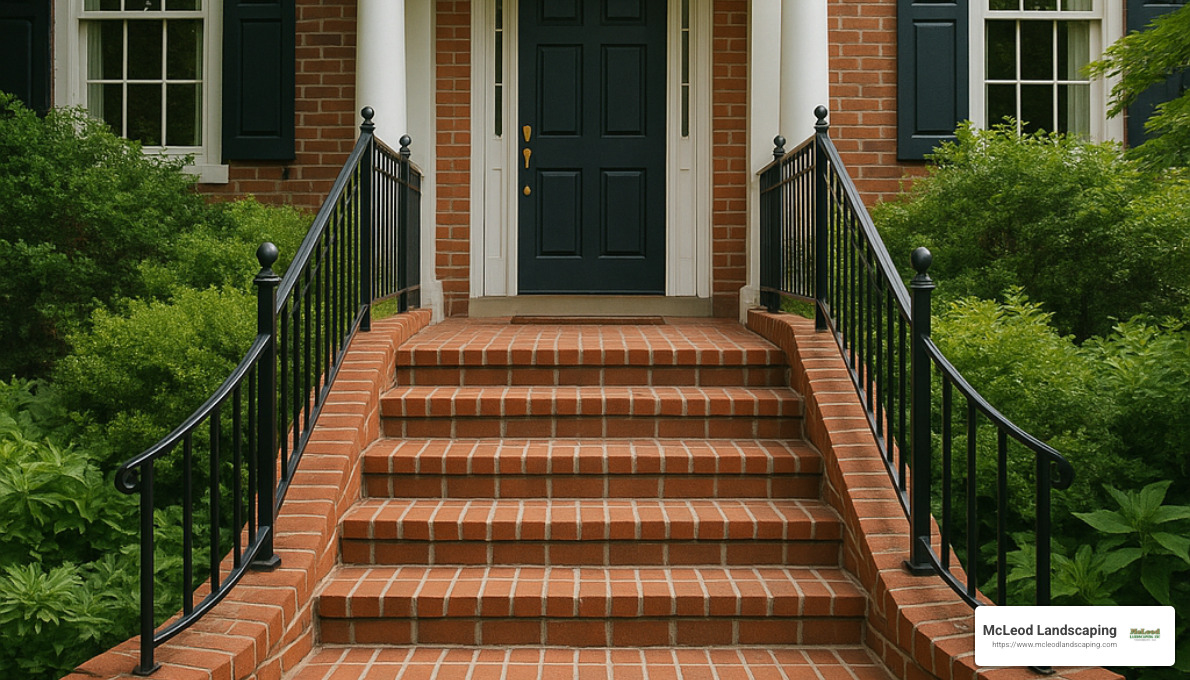
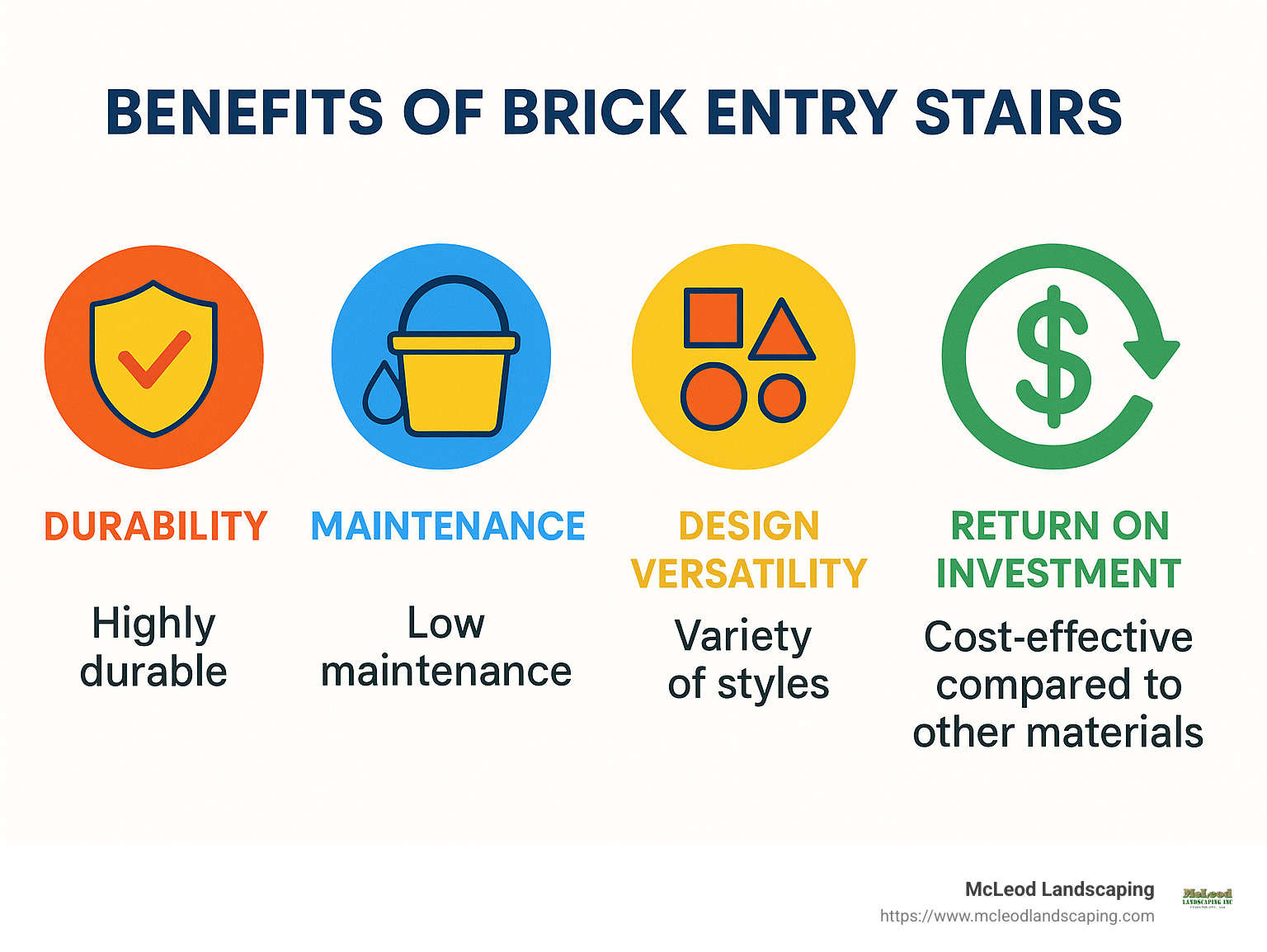
Brick entry stairs are one of the most effective ways to improve your home’s curb appeal while providing a durable, functional entrance to your property. If you’re considering upgrading your entryway, here are the key benefits of choosing brick:
The front entry of your home makes the all-important first impression on guests and passersby. Well-designed brick stairs not only serve a practical purpose but also set the tone for your entire property’s aesthetic. Whether you prefer classic red brick in a running bond pattern or a more elaborate herringbone design, brick stairs offer the perfect blend of functionality and style.
I’m Scott McLeod, owner of McLeod Landscaping with over 30 years of experience designing and installing brick entry stairs for residential and commercial properties throughout the Merrimack Valley area. My team and I have helped hundreds of homeowners transform their entryways with custom brick stair solutions that perfectly complement their homes.
When it comes to creating an entrance with enduring charm, nothing quite matches the appeal of brick entry stairs in that classic red hue. I’ve seen how these traditional staircases transform homes throughout the Merrimack Valley, bringing a touch of warmth and heritage that’s simply impossible to replicate with other materials.
The rich, earthy tones of traditional clay bricks create an instantly welcoming feeling. There’s something almost magical about the way they catch the light throughout the day, shifting from bright terracotta in morning sunshine to deep burgundy as evening approaches. This natural color variation is part of what makes red brick so captivating.
Many homeowners tell us they feel a special connection to their home after we complete their front entrance renovation. That’s the power of brick entry stairs – they don’t just connect your yard to your door; they create a sense of arrival.
These timeless staircases complement nearly any architectural style. Whether your home is a stately Colonial, a charming Cape Cod, or a handcrafted Craftsman, classic red brick provides the perfect foundation. The standard running bond pattern – where each brick is offset by half a brick’s length from the row below – isn’t just visually pleasing; it’s structurally brilliant. This arrangement prevents cracks from traveling vertically through your stairs, significantly extending their lifespan.
At McLeod Landscaping, we’re particularly attentive to the foundation preparation when installing brick stairs. New England’s notorious freeze-thaw cycles can wreak havoc on poorly constructed hardscaping. That’s why we always start with a properly compacted gravel base followed by a concrete foundation. For the mortar, we use Type M with its impressive 2500 psi compressive strength – the perfect balance of durability and flexibility for our climate.
The beauty of traditional red brick extends beyond its appearance. These stairs are remarkably practical too. They provide excellent traction in wet conditions, stand up to decades of foot traffic, and require minimal maintenance compared to wooden alternatives. A simple annual cleaning and occasional repointing of mortar joints is typically all that’s needed to keep them looking their best.
Many clients report feeling more confident walking up brick stairs in winter compared to their old concrete steps. The textured surface provides better grip, while the thermal properties of brick mean they’re less likely to form ice than some alternative materials.
Whether you’re restoring a historic property or adding character to a newer home, classic red brick stairs offer that perfect blend of tradition, functionality, and timeless appeal that continues to make them a favorite choice among homeowners who value both beauty and longevity.

There’s something magical that happens when you combine the warmth of brick with the elegance of natural stone in your entry stairs. This modern approach gives you the best of both worlds – the timeless character of brick entry stairs with the sophisticated accent of stone elements. It’s like pairing a classic button-down shirt with a stylish modern jacket – the combination just works.
Many of our clients at McLeod Landscaping are drawn to this combination because it creates instant visual interest through contrasting textures. The smooth, cool surface of stone plays beautifully against the textured, warm feeling of brick. This juxtaposition doesn’t just look good – it tells visitors that you pay attention to details.
When we design these combination stairs, we often recommend bluestone for a striking slate-blue contrast against warmer brick tones. For a more subtle look, limestone provides a light, neutral complement that lets the brick shine. If durability is your top concern, granite is tough to beat with its distinctive speckled patterns adding visual interest. And travertine stays surprisingly cool underfoot during summer months while lending a clean, sophisticated appearance.
Design experts often note that your front steps do the heavy lifting in providing a neat first impression. This perfectly captures why material combinations make such an impact – they create immediate visual interest that lifts your home’s entrance beyond the ordinary.
We’ve completed numerous projects featuring brick entry stairs with granite treads and brick risers, creating a stunning contrast. Homeowners consistently express how the combination of materials makes their entrance feel both welcoming and sophisticated – exactly the statement many want to make.
The design process for combination stairs requires thoughtful consideration of how materials interact both visually and structurally. We typically recommend using brick for the risers and stone for the treads, since stone’s superior durability makes it ideal for horizontal surfaces that take the most punishment from foot traffic and weather exposure.
From a technical standpoint, combining materials does require expertise. Different materials expand and contract at different rates through seasonal temperature changes, so proper installation techniques are essential. Our team uses specialized methods to ensure these material transitions remain stable and beautiful year after year.
One of our favorite designs uses brick in a herringbone pattern for landing areas while featuring stone treads for the steps themselves. This creates a cohesive look that highlights the best qualities of both materials – the pattern interest of the brick and the solid elegance of the stone.
When done right, a brick and stone combination creates an entrance that feels both grounded in tradition and refreshingly modern – exactly the kind of timeless design we love creating for our clients in the Merrimack Valley.

There’s something undeniably enchanting about curved brick entry stairs that straight staircases simply can’t match. These graceful, flowing designs do more than just connect different levels of your property—they create a journey, a warm invitation that guides visitors naturally toward your front door.
Many homeowners comment on how charming rounded steps look after installation. That’s precisely the reaction curved brick stairs tend to inspire. They’re not just functional; they’re conversation pieces that immediately lift your home’s curb appeal.
When we design curved brick entry stairs for our clients, the change is always remarkable. Beyond their eye-catching appearance, these staircases offer practical advantages that many homeowners don’t initially consider.
The sweeping design creates a natural pathway that feels intuitive to steer. There’s something about following a gentle curve that feels more comfortable than marching up a straight line—it’s almost as if the stairs are guiding you home.
In certain landscapes, especially those with unusual topography, curved stairs can actually make better use of available space than traditional straight designs. We’ve helped many homeowners in the Merrimack Valley area solve tricky elevation challenges with customized curved solutions.
Perhaps most importantly, curved brick stairs establish your entrance as the undeniable focal point of your home’s exterior. Homeowners frequently tell us that after installation, their house finally has the entrance it deserves, with passersby often slowing down to admire the distinctive feature.
Since each curved staircase must be custom-designed to fit your specific property, they inherently add a one-of-a-kind character that mass-produced options can’t match. And don’t underestimate the power of softened transitions—the gentle curve creates a more gradual, welcoming flow between different levels of your landscape.
Creating beautiful curved brick entry stairs requires specialized masonry expertise. Each brick must be carefully placed to maintain consistent spacing while following the desired radius. Our experienced masons at McLeod Landscaping have perfected techniques like cutting custom-shaped bricks and calculating precise mortar joints to achieve those smooth, flowing curves that look effortless but require considerable skill.
Our lead mason explains that the most challenging aspect of curved brick stairs is maintaining consistent rise and run dimensions throughout the curve. Each step must have identical height and depth to ensure safety and comfort, regardless of where along the curve you’re walking.
For a recent Brick Stairs and Walkway project in Andover, we designed a sweeping curved entrance that completely transformed an ordinary front yard. What was once a forgettable approach became the home’s defining feature, with visitors frequently commenting on the distinctive entrance.
When considering curved brick entry stairs for your own property, it’s important to work with experienced designers who understand both the aesthetic and technical requirements. The ideal curve radius depends on your property’s topography, available space, total rise needed, and your personal design preferences. Our design team at McLeod Landscaping can help you determine the perfect dimensions for your specific situation, creating an entrance that’s not just beautiful, but perfectly suited to your home’s architecture and your family’s needs.
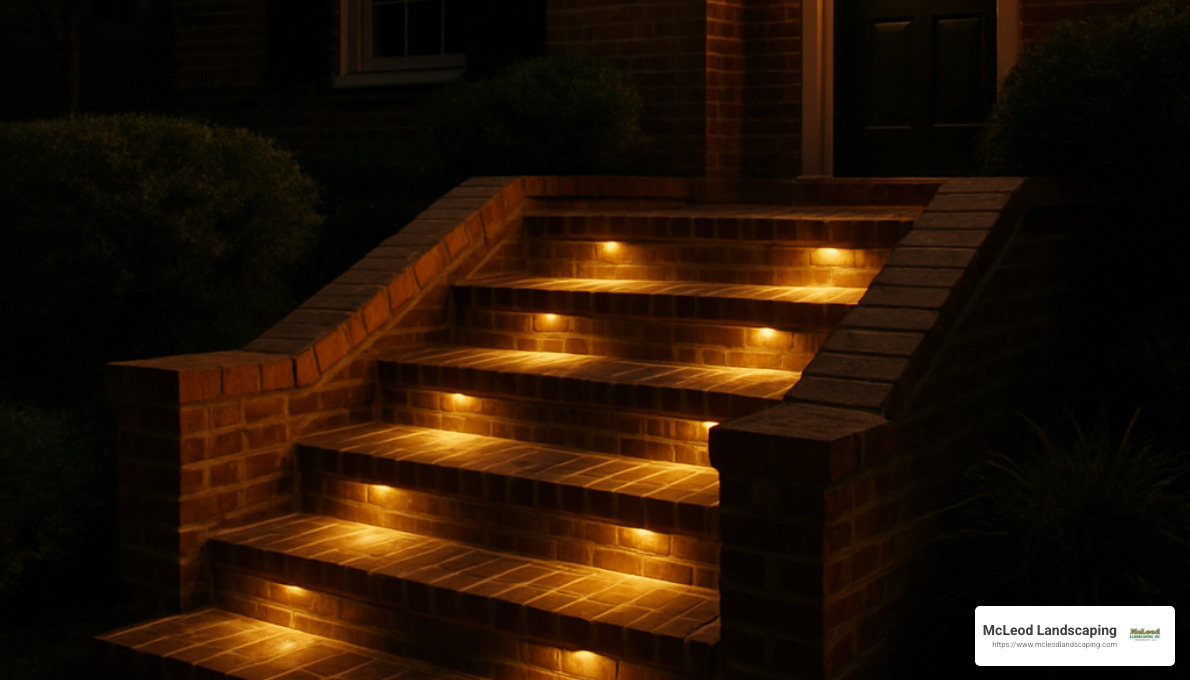
There’s something almost magical about brick entry stairs when they’re thoughtfully illuminated. Beyond just looking beautiful, proper lighting transforms your entrance into a safe, welcoming pathway that shines even after the sun goes down.
As I often tell my clients here in New England, “Your stairs should never disappear when darkness falls.” This is especially true during our long winter months when you might leave for work and return home entirely in darkness. A well-lit entrance prevents accidents and creates that warm “welcome home” feeling we all cherish.
Landscape design experts consistently note that stairway lighting is essential if the area is not well illuminated by ambient or street lighting, particularly for long or shaded stairways. I couldn’t agree more – proper illumination isn’t just decorative; it’s a practical necessity.
The beauty of lighting for brick entry stairs lies in the variety of options available. Recessed step lights create a subtle glow that highlights each step without showing the fixture itself. These look particularly neat when built directly into brick risers, where the warm light accentuates the natural texture of the bricks.
Under-cap lighting offers another subtle approach. When installed beneath stair caps or railings, these fixtures wash your stairs with gentle downward light that’s both practical and atmospheric. We’ve completed numerous projects in Andover where we used this technique, with homeowners remarking how their stairs appear to float on light at night.
Path lighting placed strategically alongside your stairs provides broader illumination while adding vertical design elements to your landscape. Meanwhile, modern LED strip lighting can create continuous, energy-efficient illumination along the entire staircase – perfect for contemporary homes.
At McLeod Landscaping, we always plan lighting during the initial design phase of brick entry stairs. This forward thinking allows us to conceal wiring and junction boxes within the structure itself, resulting in a clean, professional appearance without visible conduits or connections.
Safety remains a top priority in all our lighting designs. We carefully consider the Americans with Disabilities Act guidelines to ensure proper illumination levels and placement. The goal is creating entrances that welcome everyone safely, regardless of age or ability.
Energy efficiency matters too. Most of our installations use low-voltage LED systems that provide bright, reliable light while minimizing electricity usage. Adding photocells or timers means your entrance lights up automatically at dusk – one less thing to remember after a long day.
One of my favorite approaches combines different lighting types for a layered effect. Picture recessed lights illuminating each step paired with subtle path lighting along the approach. This creates depth and dimension that makes your brick entry stairs truly shine after dark.
Clients frequently share how lighting has completely transformed how they use their front entrance. It’s not just about safety – though that’s important with young children – but it’s also created a magical quality at night. The house feels welcoming when returning home after dark.
That’s exactly what well-designed stair lighting should accomplish – the perfect blend of practical safety and aesthetic beauty that improves your home’s entrance day and night.
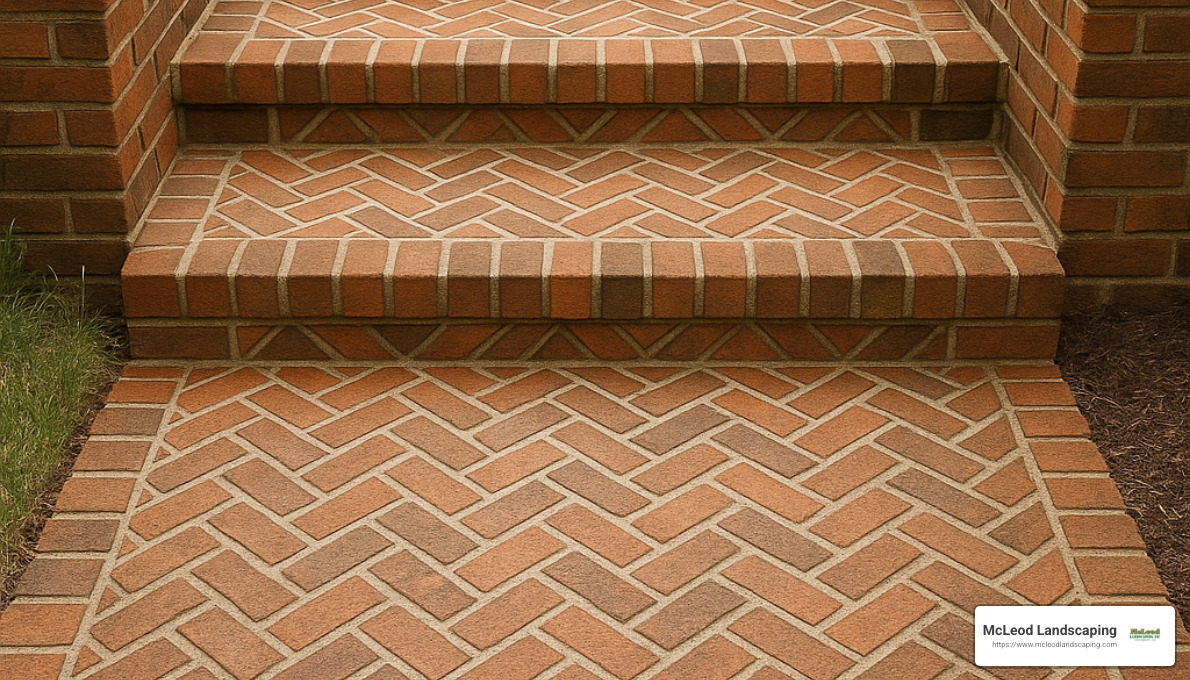
There’s something truly magical about the way brick patterns can transform a simple staircase into a work of art. The arrangement of bricks in your entry stairs isn’t just about function—it’s an opportunity to showcase craftsmanship and create a distinctive welcome to your home that visitors won’t soon forget.
As I often tell my clients at McLeod Landscaping, your brick entry stairs tell a story about your home before anyone even reaches the front door. The pattern you choose sets the tone for the entire property.
Landscape design professionals often note that brick steps can be laid in a running bond pattern or creatively arranged in patterns like herringbone to provide both visual interest and practical drainage. These thoughtful pattern choices allow you to personalize your entrance in a way that perfectly complements your home’s unique character and architectural style.
If you’re looking to add a touch of European elegance to your entryway, the herringbone pattern is hard to beat. With its distinctive zigzag appearance, this classic design creates a sense of dynamic movement that naturally draws the eye toward your entrance. There’s a reason this pattern has adorned streets and courtyards across Europe for centuries—it simply exudes sophistication.
Creating a herringbone pattern requires skilled craftsmanship. Our masons arrange each brick at 45-degree angles to one another, forming a series of “V” shapes across the surface. Beyond just looking beautiful, this arrangement actually distributes weight more evenly than standard patterns, potentially extending the life of your stairs—a practical benefit beyond the obvious aesthetic appeal.
A Design guide on entry stairways emphasizes that “a stairway should be a conscious—and creative—statement.” The herringbone pattern embodies this philosophy perfectly, elevating your brick entry stairs from merely functional to truly artistic.
We’ve completed numerous projects for historic homes where homeowners wanted something special that would honor their home’s architectural style. Herringbone brick entry stairs provide a subtle nod to traditional New England craftsmanship while creating a truly memorable entrance. Clients consistently remark that the pattern makes all the difference – it’s these details that make an entrance feel special.
For homeowners seeking a pattern with a bit more geometric precision, the basketweave design creates a stunning visual effect. True to its name, this pattern resembles an interwoven basket, typically alternating pairs of bricks laid horizontally and vertically to create a distinctive checkerboard effect.
Basketweave patterns really shine on larger landings or wider staircases where the pattern has room to develop visually. There’s something inherently formal about this arrangement that pairs beautifully with traditional architecture styles. The pattern creates a sense of order and intention that lifts your entire entrance.
When installing these ornate patterns, our team at McLeod pays meticulous attention to the details that make all the difference. Consistent 3/8-inch mortar joints ensure the pattern appears uniform and precise. We use Type M mortar with its impressive 2500 psi compressive strength—perfect for standing up to New England’s challenging climate while allowing for the precise joint work these intricate patterns demand.
Landscape architects often remind clients that the classic design works for many architectural styles of homes. This versatility makes ornate brick patterns an excellent choice whether your home is a stately Colonial, charming Victorian, rustic Craftsman, or sleek Contemporary.
One of my favorite recent projects was in Westford, where we combined patterns to create visual interest. We used a basketweave pattern for the landing and a running bond pattern for the stair risers. The contrast between the two arrangements highlighted the craftsmanship while maintaining a cohesive overall design. It’s this kind of thoughtful detail that transforms ordinary stairs into an extraordinary entrance.
When you’re considering pattern options for your brick entry stairs, these details aren’t just decorative—they’re an expression of your home’s personality and your attention to detail. A well-executed pattern creates an entrance that welcomes visitors with both warmth and style.
There’s something undeniably special about walking up stairs made from bricks that have already lived a full life. Reclaimed brick entry stairs bring a sense of history and character that new materials simply can’t match, all while making an environmentally responsible choice for your home.
These salvaged treasures typically come from old factories, historic downtown buildings, or century-old homes being renovated. Each brick carries its own story – perhaps from a 19th-century mill in Lowell or a colonial-era building in Boston. The subtle variations in color, the slight irregularities in shape, and the gentle weathering that’s occurred over decades give reclaimed brick its distinctive charm.
Homeowners frequently express their love for reclaimed brick stairs immediately after installation. Many report that neighbors ask if the stairs are original to their historic homes – exactly the look many people want to achieve.
The environmental benefits of choosing reclaimed brick are substantial. By repurposing existing materials, you’re keeping perfectly usable bricks out of landfills. You’re also eliminating the energy that would be required to manufacture new bricks, which involves clay extraction, firing at high temperatures, and transportation – all processes with significant carbon footprints.
At McLeod Landscaping, we’ve developed relationships with architectural salvage companies throughout New England to source high-quality reclaimed brick. This network allows us to find materials that match the period and style of your home, creating an entrance that feels authentic and thoughtfully designed.
Working with reclaimed brick does require specialized knowledge. Our masons carefully clean each brick, removing old mortar without damaging the aged patina that gives them their distinctive character. We inspect each piece to ensure structural integrity – not every reclaimed brick is suitable for load-bearing applications like stairs.
One particularly memorable project involved a Federal-style home in Tewksbury where we sourced 200-year-old bricks from a demolished warehouse in Salem. The rich, varied hues of rusty red, burgundy, and even purplish tones created an entrance with immediate presence and gravitas. The homeowners later told us that delivery drivers often comment on how beautiful their stairs are – not something you typically hear about a utilitarian feature like entry stairs!
The rustic charm of reclaimed brick pairs beautifully with other natural elements. For many projects, we combine reclaimed brick entry stairs with native plantings, natural stone accents, or vintage ironwork to create a cohesive, timeless entrance design. These combinations honor New England’s architectural heritage while creating a uniquely personal welcome to your home.
It’s worth noting that reclaimed brick does typically cost more than new materials – both because of the labor involved in salvaging and preparing the bricks and because of their inherent value as architectural artifacts. However, many homeowners find the additional investment worthwhile for the distinctive character and environmental benefits these materials provide.
Whether you’re restoring a historic property or adding authentic character to a newer home, reclaimed brick entry stairs offer a sustainable choice that connects your entrance to the past while creating beauty that will last well into the future.
When homeowners ask me about the cost of brick entry stairs, I always start with “it depends” – because it truly does! Just like no two homes are exactly alike, neither are two stairway projects.
The price tag for your dream brick entrance will vary based on several key factors. The size and complexity of your design plays a major role – a simple straight staircase costs considerably less than an elaborate curved design with custom patterns. The type of bricks you select matters too, with standard pavers being more affordable than handmade or reclaimed options.
Based on industry averages I’ve researched online, materials for brick stairs typically run about $4 to $6 per square foot. Labor is where costs can really add up, with professional installation ranging from $50 to $100 per hour depending on your location and the complexity of the work.
For perspective, a straightforward project with 3-5 steps might fall at the lower end of the spectrum, while those gorgeous curved staircases with herringbone patterns and integrated lighting you’ve been admiring on Pinterest? Those premium projects can easily cost three times more than standard installations.
At McLeod Landscaping, Scott and his team always provide detailed, personalized quotes after visiting your property and discussing your specific needs. This approach ensures you receive an accurate estimate custom to your unique project rather than relying on generic price ranges that might not apply to your situation.
Taking care of your brick entry stairs doesn’t have to be complicated, but a little regular attention goes a long way toward preserving their beauty and function for decades to come.
Monthly maintenance is simple – grab a broom and sweep away leaves, dirt, and debris that tend to accumulate. A quick rinse with your garden hose keeps things looking fresh. For stubborn stains (like those mysterious dark spots that appear after a rainstorm), a gentle scrub with mild detergent and a soft brush usually does the trick.
Twice a year, preferably in spring and fall, take a closer look at your stairs. Check for any loose bricks or crumbling mortar that might need attention. This is also the perfect time to pull any persistent weeds that have found their way between the bricks. A leaf blower works wonders for clearing debris from tight joints.
Prevention is much easier than repair. Catching small issues early can save you from costly repairs down the road.
Once a year, consider a gentle pressure washing (keep it under 1500 psi to avoid damaging the bricks) to deep clean your stairs. Every 3-5 years, applying a quality sealer helps protect against moisture penetration and staining, especially important in our harsh New England climate.
Winter requires special care – avoid metal shovels that can chip your beautiful brickwork, and steer clear of harsh deicing chemicals that can damage both brick and mortar. Instead, opt for plastic snow removal tools and pet-friendly ice melt products specifically designed for masonry surfaces.
If you notice significant damage or deterioration, don’t wait – McLeod’s Brick Stair Repair services can address problems before they worsen and compromise the structural integrity of your stairs.
Yes, you absolutely can paint or stain your brick entry stairs – and the results can be truly transformative! I’ve seen countless tired, mismatched brick entrances completely revitalized with a fresh coat of quality paint.
Many homeowners describe the change as like getting a brand new entrance for a fraction of the cost. Faded, 1970s orange-brick steps can be transformed with sophisticated charcoal gray that perfectly complements updated home exteriors.
If you’re considering painting your brick stairs, proper preparation is critical. Start with a thorough cleaning to remove all dirt, moss, and loose material. Repair any damaged mortar joints, then allow everything to dry completely before painting – moisture trapped under paint is a recipe for future problems.
Choose your products wisely. Look for exterior-grade masonry paint specifically formulated for brick surfaces. For the treads (the horizontal walking surfaces), select a porch and floor enamel designed to withstand foot traffic. Many professionals recommend breathable mineral-based paints that allow moisture to escape rather than becoming trapped in the brick.
Application technique matters too. Use a brush to carefully paint the mortar lines first, then roll the larger surfaces. Several thin coats provide better results than one thick layer, and always allow proper drying time between coats – usually at least 4 hours, but follow the manufacturer’s recommendations.
It’s worth noting that painted brick requires ongoing maintenance. You’ll likely need to repaint every 3-5 years, and you should touch up chips or worn spots promptly to prevent moisture penetration.
For homeowners who love the natural look of brick but want to improve its appearance, staining offers a beautiful alternative to paint. Brick stains penetrate the surface rather than coating it, preserving the natural texture while altering or deepening the color.
While we generally recommend preserving the natural beauty of new brick installations, painting can be the perfect solution for older stairs with damaged or mismatched bricks, or when a specific design vision calls for it.
There’s something magical about a beautiful brick entrance that welcomes you home each day. Brick entry stairs do more than just connect your yard to your front door – they make a statement about your home and create that crucial first impression that stays with visitors long after they’ve left.
Throughout this article, we’ve explored the remarkable versatility of brick stairs. From the timeless charm of classic red brick to the sophisticated allure of curved designs, the options truly are endless. Whether you’re drawn to the eco-friendly character of reclaimed materials or the dramatic effect of integrated lighting, brick provides a canvas for creating an entrance that perfectly reflects your personal style.
I’ve seen how a thoughtfully designed entrance transforms not just the look of a home, but how people feel when they approach it. A well-crafted brick stairway creates a sense of arrival – that special transition from the outside world into your personal space. It guides visitors naturally toward your door while making a subtle statement about the care and attention you’ve invested in your home.
The beauty of brick entry stairs goes beyond aesthetics. These durable structures stand up to New England’s demanding weather conditions year after year, often becoming more beautiful with age as they develop that distinctive patina that only time can create. When properly installed with attention to proper drainage and foundation work, your brick stairs will likely outlast many other elements of your landscape.
From a practical perspective, investing in quality brick stairs makes financial sense too. Beyond the daily enjoyment they provide, well-designed entrances consistently rank among the home improvements that offer the best return on investment when it comes time to sell. Potential buyers form impressions within seconds of seeing your home, and a beautiful brick entrance sets exactly the right tone.
At McLeod Landscaping, we’ve spent over three decades perfecting the art and science of creating beautiful, lasting brick entrances throughout the Merrimack Valley. We understand that the details matter – from the precise slope that ensures proper drainage to the subtle design elements that complement your home’s architecture. Every brick, every joint, and every curve contributes to creating stairs that will remain both beautiful and functional for decades.
Ready to transform your home’s entrance? We’d love to help you explore the possibilities. Our team brings decades of experience to every project, ensuring that your new brick entry stairs will improve your home’s beauty, functionality, and value for years to come.
Take the next step toward your dream entrance by exploring our walkway and stairs services or reaching out to schedule a consultation. We’ll walk you through the options, address your questions, and help you create an entrance that perfectly complements your home and landscape.
Consider partnering with McLeod Landscaping for expert design and installation of your brick entry stairs. From the initial concept to the final touches, we’ll work with you to create an entrance that welcomes you home beautifully every single day.
Contact McLeod Landscaping today at (978) 640-0957 or click here to schedule a consultation for retaining wall installation. Let our experienced team design and install a functional and visually appealing retaining wall that enhances your landscape.


1881 Main St Unit 1, Tewksbury, MA 01876