
A sloped yard can feel like a wasted opportunity—difficult to mow, impossible to furnish, and prone to washing out in heavy New England downpours. The solution is to build a retaining wall on a slope, a project that does more than just hold back dirt. It’s about reclaiming your property, changing unusable hillside areas into stunning, functional outdoor spaces, all while preventing costly soil erosion and protecting your home’s foundation. A well-built wall can create a level patio for summer barbecues, terraced beds for a vibrant garden, or a safe, flat play area for your family.
Mastering a slope requires a solid plan. Here are the essential steps to build a retaining wall on a slope that will last:
As research shows, gravity retaining walls are suitable for heights up to 3 meters, while walls over 4 feet in our region almost always require professional engineering and permits from your local town hall. The number one cause of retaining wall failure is poor drainage, making water management the key to success.
The primary purpose of retaining walls on slopes is to create level, usable areas from challenging terrain. They stop soil erosion from stripping away valuable topsoil, add significant value and curb appeal to your property, and enable beautiful terraced gardens or expansive outdoor living spaces. However, building on slopes presents unique challenges. Steeper slopes exert exponentially more pressure, demanding stronger, engineered designs. Water flows faster down a slope, increasing the risk of erosion at the base of the wall if not managed correctly. Furthermore, the uneven ground makes the critical task of leveling the base and each course of blocks far more difficult.
I’m Scott McLeod, and over my 30+ years in the landscaping industry, I’ve helped hundreds of property owners successfully build a retaining wall on a slope throughout the Merrimack Valley, from Andover to Westford. My team at McLeod Landscaping has mastered the techniques needed to transform challenging hillsides in communities like Tewksbury, Billerica, and Chelmsford into beautiful, functional outdoor spaces that stand the test of time.
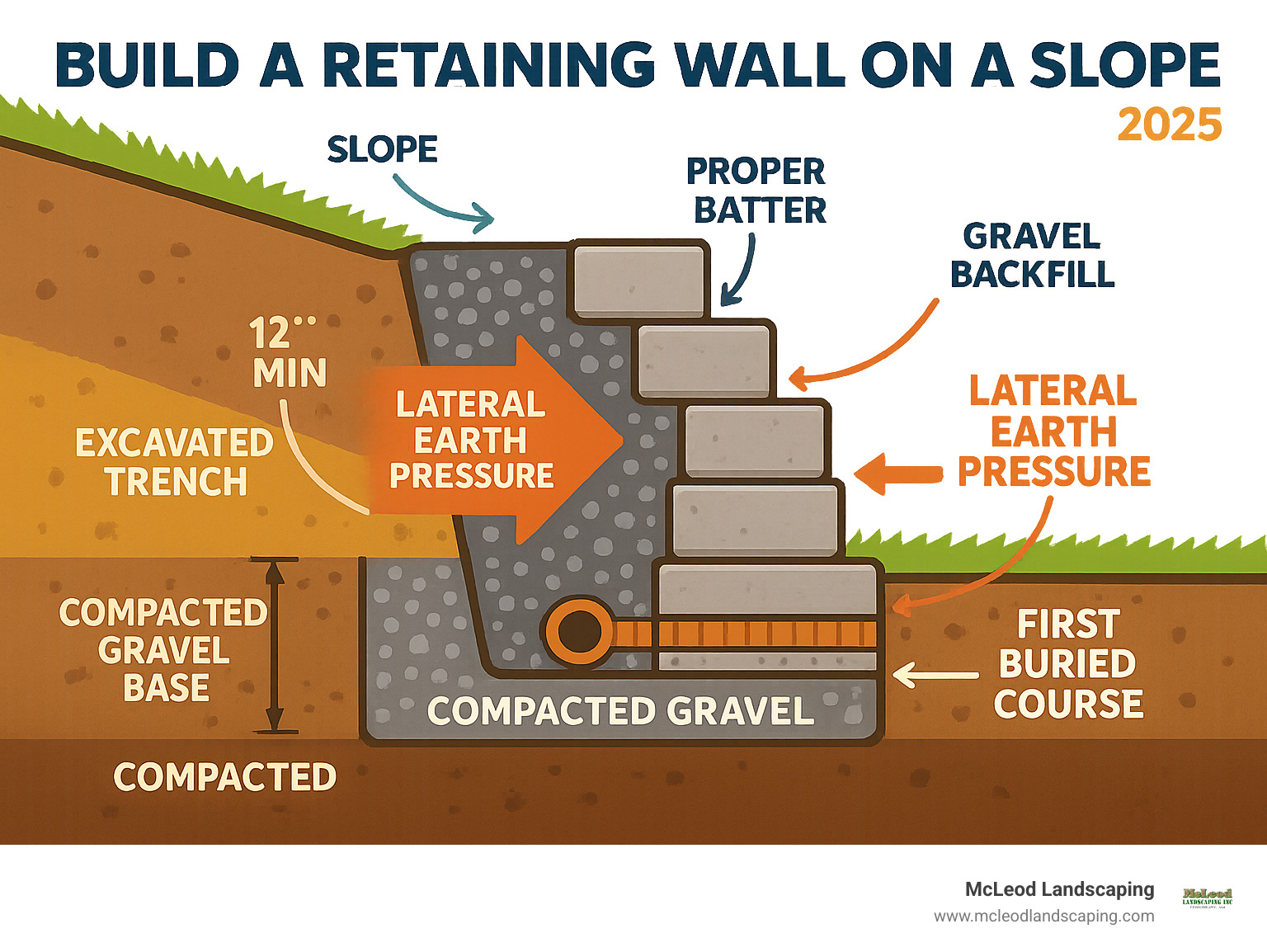
Build a retaining wall on a slope terminology:
The most critical step when you build a retaining wall on a slope isn’t picking up that first shovel – it’s sitting down with a cup of coffee and carefully planning every detail. Trust me, spending time on thoughtful design now will save you from headaches, backaches, and potentially expensive repairs later. A successful wall is built on paper long before it’s built on your property.

Your first mission is a thorough site assessment. Start by examining the slope angle. For a simple DIY check, drive a stake at the top of the slope and one at the bottom. Run a level string line between them and measure the vertical drop and horizontal distance. A slope that doesn’t exceed a 2:1 ratio (two feet horizontal for every one foot vertical, or about 26 degrees) is generally manageable for DIY projects. If you’re looking at something closer to 45 degrees, you’re entering territory that absolutely requires professional engineering expertise.
Next, dig into understanding your soil type. Here in Massachusetts, we often encounter heavy clay soils that hold onto water like a sponge. This creates immense hydrostatic pressure behind your wall, making drainage the top priority. Sandy soils drain well but can be less stable. You can perform a simple “jar test”: fill a mason jar one-third full of your soil, top it with water, shake vigorously, and let it settle for a day.
The layers that form (sand on the bottom, silt in the middle, clay on top) will give you a good idea of your soil’s composition. Finally, take time to observe water flow patterns during heavy rain. Note where water pools or runs, as this will inform your drainage strategy.
Before any digging begins, always call 811 to locate underground utilities. This simple, free call could save you from a dangerous and expensive mistake. You’ll also want to check local building codes and permit requirements. Most municipalities around Tewksbury, MA, including Billerica and Wilmington, require permits for walls over 3 to 4 feet tall, or any wall supporting critical loads (known as “surcharges”) like driveways or structures.
While many smaller retaining walls make excellent DIY projects, there are clear situations where calling in a professional engineer isn’t just smart – it’s essential for safety, longevity, and code compliance.
You should always seek professional engineering for:
A structural engineer performs critical calculations to account for lateral earth pressure, potential surcharge loads, and soil mechanics. They will provide a stamped plan specifying the required base depth, reinforcement (like geogrid), and drainage system to ensure your wall’s long-term integrity and meet local building codes.
More info about Retaining Wall Design
Don’t forget about frost considerations in our New England climate. Your wall’s foundation must extend below the local frost line to prevent “frost heave”—the process where trapped water in the soil freezes, expands, and pushes your wall upward, causing it to shift, crack, and fail.
Find your area’s frost line depth
Several critical design factors guide success when you build a retaining wall on a slope. Getting these right makes the difference between a wall that lasts decades and one that fails within a few seasons.
Your material choice significantly impacts your retaining wall’s appearance, durability, cost, and installation difficulty. Each option brings distinct advantages and challenges worth understanding before making your decision.
| Material Type | Pros | Cons – | Average Cost per sq. ft.* |
|---|---|---|---|
| Interlocking Concrete Blocks | DIY-Friendly: Uniform shape and interlocking design make for faster, easier installation. Versatile: Wide range of colors, textures, and sizes available. Durable: Engineered for strength and longevity. – | Less Natural Look: Can look manufactured compared to natural stone. Limited Height: Taller walls require geogrid reinforcement. Can Effloresce: May develop a white, powdery mineral deposit on the surface over time. – | $25 – $85 |
| Pressure-Treated Timber | Cost-Effective: Often the least expensive material option, especially for DIY. Easy to Cut & Install: Wood is easy to work with using standard tools. Rustic Aesthetic: Provides a natural, warm look that blends well with landscapes. – | Limited Lifespan: Will eventually rot, typically lasting 15-20 years. Susceptible to Pests: Can be damaged by termites or other insects. Chemicals: Treated with chemicals that may not be suitable for use near vegetable gardens. – | $20 – $80 |
| Natural Stone | Best Beauty: Offers a timeless, high-end aesthetic. Extremely Durable: Can last a lifetime with proper installation. Unique: Every stone is different, creating a one-of-a-kind wall. – | High Cost: The most expensive material and labor-intensive option. Difficult Installation: Requires significant skill and labor to fit irregular stones. Heavy: Material is heavy and difficult to transport and handle. – | $40 – $280+ |
| Poured Concrete | Extremely Strong: Offers superior strength and durability, ideal for large, critical walls. Customizable: Can be formed into curves and unique shapes. Can be Faced: Can be finished with stone veneer or stucco for a better look. – | Industrial Look: Can appear stark and commercial without a finish. Expensive: Requires professional installation and extensive formwork. Prone to Cracking: Can crack over time if not properly installed with control joints and rebar. | $60 – $210 |
Note on costs: All prices are national averages based on online data and do not reflect McLeod Landscaping’s pricing. Costs can range from $20 to over $280 per square foot depending on material, wall height, site accessibility, and overall project complexity.
Interlocking Concrete Blocks: These are the workhorses of the modern retaining wall. Engineered for a precise fit, they often feature a rear lip that helps with alignment and setback. Their popularity stems from the balance they strike between strength, ease of installation, and aesthetic variety. They come in countless colors, faces (e.g., split-face, smooth, rustic), and sizes, allowing for a high degree of customization to match your home’s style.
Pressure-Treated Timber: For a more rustic or naturalistic look, timber walls are a classic choice. They are often the most budget-friendly option, especially if you’re comfortable with the DIY installation. However, their organic nature is also their biggest drawback. Even when properly treated, wood is in constant contact with damp soil and will eventually succumb to rot and insect damage, requiring replacement sooner than masonry options.
Natural Stone: For a truly premium, timeless look, nothing beats natural stone. Whether you choose a formal, mortared wall of cut ashlar or a rustic, dry-stacked fieldstone wall, the result is a unique feature that looks like it has always been part of the landscape. This beauty comes at a cost, however, as building with irregular, heavy stones is a slow, labor-intensive art that requires true craftsmanship.
Poured Concrete: When absolute strength is the top priority, poured concrete is the answer. These are the types of walls you see in major civil engineering projects. For residential applications, they are typically reserved for the most demanding situations, such as very tall walls or those holding back a driveway on a steep grade. While incredibly strong, a plain concrete finish can be visually harsh, so they are often faced with a more attractive material like stone veneer or stucco.
More info about Retaining Wall Blocks
Contact McLeod Landscaping today at (978) 640-0957 or click here to schedule a consultation for retaining wall installation. Let our experienced team design and install a functional and visually appealing retaining wall that enhances your landscape.


1881 Main St Unit 1, Tewksbury, MA 01876