
Concrete step repair is essential for maintaining safety and curb appeal, addressing common issues like cracks, spalling, and crumbling edges before they become dangerous or require costly replacement. Here’s what you need to know:
Quick Answer: Concrete Step Repair Process
Those crumbling concrete steps leading to your front door aren’t just an eyesore—they’re a safety hazard waiting to happen. As one forum user aptly put it after winter damage: “I noticed that the top riser of my concrete stairs leading to my front door have started to crumble a bit. I am assuming that some water has made its way into the concrete, and the freeze/thaw cycle had popped off some of the concrete.”
The good news? You don’t always need to replace them. Modern repair materials and techniques have changed the game. Where a maintenance crew might have replaced crumbling steps a decade ago, today’s products make stable, long-lasting repairs possible—often at a fraction of the cost.
The reality is stark: damaged steps can lead to costly lawsuits, decreased property values, and serious injuries. But with the right approach, most concrete step repairs are achievable DIY projects that can save you hundreds or even thousands of dollars.
I’m Scott McLeod, owner of McLeod Landscaping, and over 30 years I’ve helped hundreds of property owners in the Merrimack Valley restore their concrete steps, stairs, and walkways. Whether you’re tackling concrete step repair yourself or evaluating whether to call in professionals, this guide will walk you through exactly what you need to know.
Concrete step repair word roundup:
Before you roll up your sleeves and dive into repairs, let’s take a moment to play detective. Not every damaged concrete step needs a patch job—sometimes, the kindest thing you can do for your wallet (and your safety) is to start fresh with a replacement.
At McLeod Landscaping, we’ve seen it all over the past three decades. And here’s what we’ve learned: understanding what caused the damage in the first place is just as important as fixing it.
So what’s attacking your concrete steps? Even though concrete is incredibly durable—the Colosseum is still standing after 2,000 years, after all—it’s not invincible. Here in the Merrimack Valley, we see the same culprits over and over again.
Freeze-thaw cycles are public enemy number one. Water sneaks into tiny cracks, freezes (expanding by up to 9%), then thaws. Repeat this cycle a few hundred times each winter, and even the toughest concrete starts to crumble. It’s like giving your steps a slow-motion beating, season after season.
De-icing salts don’t help matters. They keep you from slipping on icy mornings, but they also accelerate deterioration, causing that characteristic flaking and chipping we call spalling. They can even corrode any steel reinforcement hiding inside your steps.
Then there’s water penetration. Poor drainage around your steps means constant moisture exposure, which weakens concrete like a sponge left in the sink. Water pooling at the base or on the treads? That’s a recipe for accelerated freeze-thaw damage.
Sometimes the problem is structural overload or settlement. Maybe the soil beneath your steps is shifting, or perhaps they were never properly supported in the first place. When steps sink, settle, or develop cracks that run all the way through, you’re looking at something more serious than surface damage.
Less commonly, we see chemical reactions like alkali-aggregate reaction or sulfate attack causing internal expansion and cracking. And good old-fashioned wear and tear from foot traffic can gradually erode the surface over time.
Now, what should you actually look for when inspecting your steps? Start with cracks—they can be hairline thin or wide enough to stick your finger in. The size and location tell the story. Spalling and chipping show up as flakes or chunks breaking off the surface, especially on the edges. Crumbling edges are exactly what they sound like—the corners and nosings literally falling apart.
If you notice sinking or settling steps—where one step is noticeably lower than the others or pulling away from your house—that’s a red flag waving at you. Deep fractures that go all the way through the step are another serious concern. And if you tap your step with a hammer and hear a hollow sound? That’s delamination, an undersurface fracture that’s harder to spot but just as problematic.
Here’s the truth: addressing minor damage now is a smart investment. Based on general industry data, professional repairs for minor issues can range from a few hundred dollars to over $1,500, depending on the complexity. Please note that these figures are broad industry averages, not a quote from McLeod Landscaping. Ignoring the problem until someone trips and gets hurt? That’s when you’re looking at thousands in medical bills or legal fees. As we always say at Stairs and Walkways Safety, prevention beats lawsuits every single time.
Good news—if your damage is localized and superficial, concrete step repair is totally doable. This is the sweet spot for DIY fixes or minor professional work.
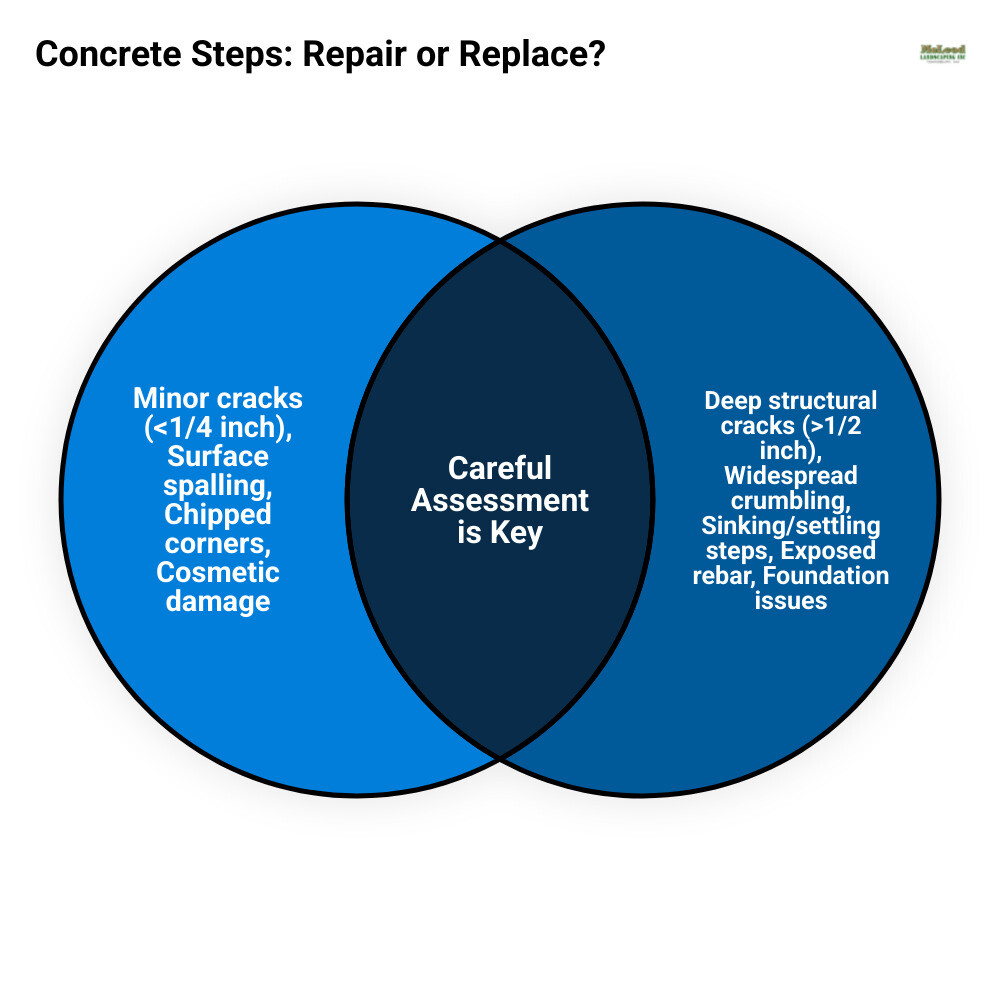
Minor cracks less than 1/4 inch wide are perfect candidates for repair. These hairline fissures aren’t structural concerns; they’re just annoying. A good masonry crack filler or concrete repair caulk handles them beautifully.
Chipped corners or edges where small pieces have broken off? These are cosmetic issues that respond well to patching. Same goes for surface spalling—that flaking or shallow pitting you see after a rough winter. It looks bad, but it’s usually just skin deep.
Small-scale damage affecting only a portion of one step, without compromising the step’s overall strength, is repairable. Think of it like fixing a dent in your car door versus replacing the entire door—sometimes a touch-up is all you need.
Sometimes, though, the damage runs too deep. When we evaluate steps for our Hardscape Repair Services, certain things make us shake our heads and recommend replacement instead.
Large structural cracks wider than 1/2 inch, especially ones that extend through the entire step or show signs they’re still moving, aren’t fixable with a patch. You’re trying to hold together something that’s fundamentally broken.
Sinking or settling steps signal underlying soil or foundation problems. No amount of surface repair fixes what’s happening six inches underground. If your steps are pulling away from your house or one step sits noticeably lower than its neighbors, the problem is bigger than the concrete itself.
Widespread crumbling is another deal-breaker. When the concrete is deteriorating in multiple areas, exposing the aggregate, or feels soft and powdery to the touch, it’s lost its structural integrity. You can’t patch your way out of that.
Severe deterioration affecting more than 25-30% of the step’s surface means you’re throwing good money after bad with repairs. And if you can see corroded, exposed reinforcing steel? That step is done. The rust will continue spreading like cancer through the concrete.
Foundation issues require a different conversation entirely. If your steps’ deterioration stems from a larger foundation problem, you need to fix the root cause first. Our team can help you determine whether you’re looking at a step problem or a foundation problem—and believe me, there’s a big difference in both scope and cost.
Not sure which category your steps fall into? That’s exactly what we’re here for. Our Concrete Stairs and Walkways specialists can give you an honest assessment. After 30 years serving properties throughout the Merrimack Valley, we’ve gotten pretty good at telling the difference between “let’s fix this” and “let’s start over.”
Alright, you’ve assessed the situation and decided that concrete step repair is the way to go. Fantastic! Now it’s time to gather your gear. Just like any good project, proper preparation—including having the right tools and materials—is half the battle. And, of course, safety first!

Before we start chipping away at anything, let’s talk about keeping yourself safe. Concrete work, even small repairs, can be dusty and involve materials that aren’t exactly skin-friendly. I can’t stress this enough: always wear eye protection—safety glasses or goggles are non-negotiable. Concrete dust and flying chips can cause serious eye injuries.
Your hands need protection too. Concrete is alkaline, which means it can irritate or even burn your skin with prolonged contact. A good pair of heavy-duty work gloves will save you from painful chemical burns and cuts. And speaking of dust, you’ll want a dust mask or respirator (N95 or better) when chipping out old concrete or mixing repair materials. Trust me, your lungs will thank you.
If you’re working with repair materials that emit fumes, make sure you have proper ventilation. Work outdoors when possible, or open windows and doors if you’re in an enclosed space. And don’t forget sturdy, closed-toe shoes—you don’t want a hammer or chunk of concrete landing on your foot. Before you use any chemical products, take a minute to review the Material Safety Data Sheets (MSDS). It sounds boring, but knowing what you’re working with can prevent accidents.
Not all concrete repair products are created equal, and choosing the right one makes all the difference between a repair that lasts years and one that fails by next spring. The market offers several options, each designed for specific types of damage. For more complex repairs, you might consider professional Masonry Services.
Concrete patching compound is your go-to for surface repairs like spalling or shallow divots. It’s designed to bond well with existing concrete and can be smoothed to match the surrounding surface. Mix it to a thick, pancake batter consistency for best results.
For those annoying hairline cracks that seem to appear out of nowhere, epoxy or polyurethane fillers are the answer. These materials penetrate deep into fine cracks and create a flexible, waterproof seal that prevents water infiltration—the main culprit behind freeze-thaw damage. They’re particularly good for cracks that are still structurally sound but need to be sealed.
When you’re dealing with broken corners or edges, quick-setting cement is your friend. It sets up fast, which means less waiting around, and it’s strong enough to rebuild structural elements like step nosings. You’ll typically need to build a form to hold it in place while it cures, but we’ll get to that in the next section.
| Material Type | Best Use | Consistency | Typical Set Time | Notes |
|---|---|---|---|---|
| Concrete Patching Compound | Surface repairs, spalling, shallow divots | Thick pancake batter | 2-4 hours | Good for matching existing texture |
| Epoxy/Polyurethane Fillers | Fine cracks, sealing | Liquid to paste | 30 minutes – 2 hours | Excellent water resistance |
| Quick-Setting Cement | Corners, edges, structural repairs | Firm putty | 15-30 minutes | Requires forming for edges |
You don’t need a contractor’s entire workshop to tackle concrete step repair, but having the right tools makes the job infinitely easier. Here’s what you’ll need: a cold chisel and hammer or mallet for removing loose concrete (this is where the real fun begins), a wire brush for cleaning debris from cracks and damaged areas, and both a margin trowel and finishing trowel for applying and smoothing your repair material.
You’ll also need a mixing bucket and measuring container for preparing your repair compound—following the manufacturer’s mixing instructions is crucial for proper curing. If you’re repairing edges or corners, have some wood scraps for building forms along with screws or nails to secure them. And if you really want to do it right, a pressure washer (or at least a garden hose with good pressure) will help you thoroughly clean the repair area before you start.
For detailed guidance on concrete repair techniques, the Guide to Concrete Repair from the U.S. Bureau of Reclamation is an excellent resource. It covers everything from material selection to proper application techniques, and it’s free to download.
Contact McLeod Landscaping today at (978) 640-0957 or click here to schedule a consultation for retaining wall installation. Let our experienced team design and install a functional and visually appealing retaining wall that enhances your landscape.


1881 Main St Unit 1, Tewksbury, MA 01876