
Building a retaining wall is one of the most impactful DIY projects you can tackle to transform your landscape. Here’s what you need to know:
Quick Answer for Building a Retaining Wall:
A retaining wall does much more than just hold back soil. It prevents erosion, creates usable outdoor space on slopes, and adds significant aesthetic value to your property. Whether you’re dealing with a hillside that’s washing away or want to create terraced garden beds, a properly built retaining wall provides the structural support your landscape needs.
The key to success lies in understanding that most retaining wall failures happen because of two critical mistakes: poor drainage and inadequate foundation preparation. When water builds up behind your wall without proper drainage, it creates enormous pressure that can cause even well-built walls to fail.
I’m Scott McLeod, and over my three decades of experience with McLeod Landscaping, I’ve seen countless examples of both successful and failed retaining wall projects. Building a retaining wall requires attention to detail, proper materials, and understanding the forces at work behind that wall.
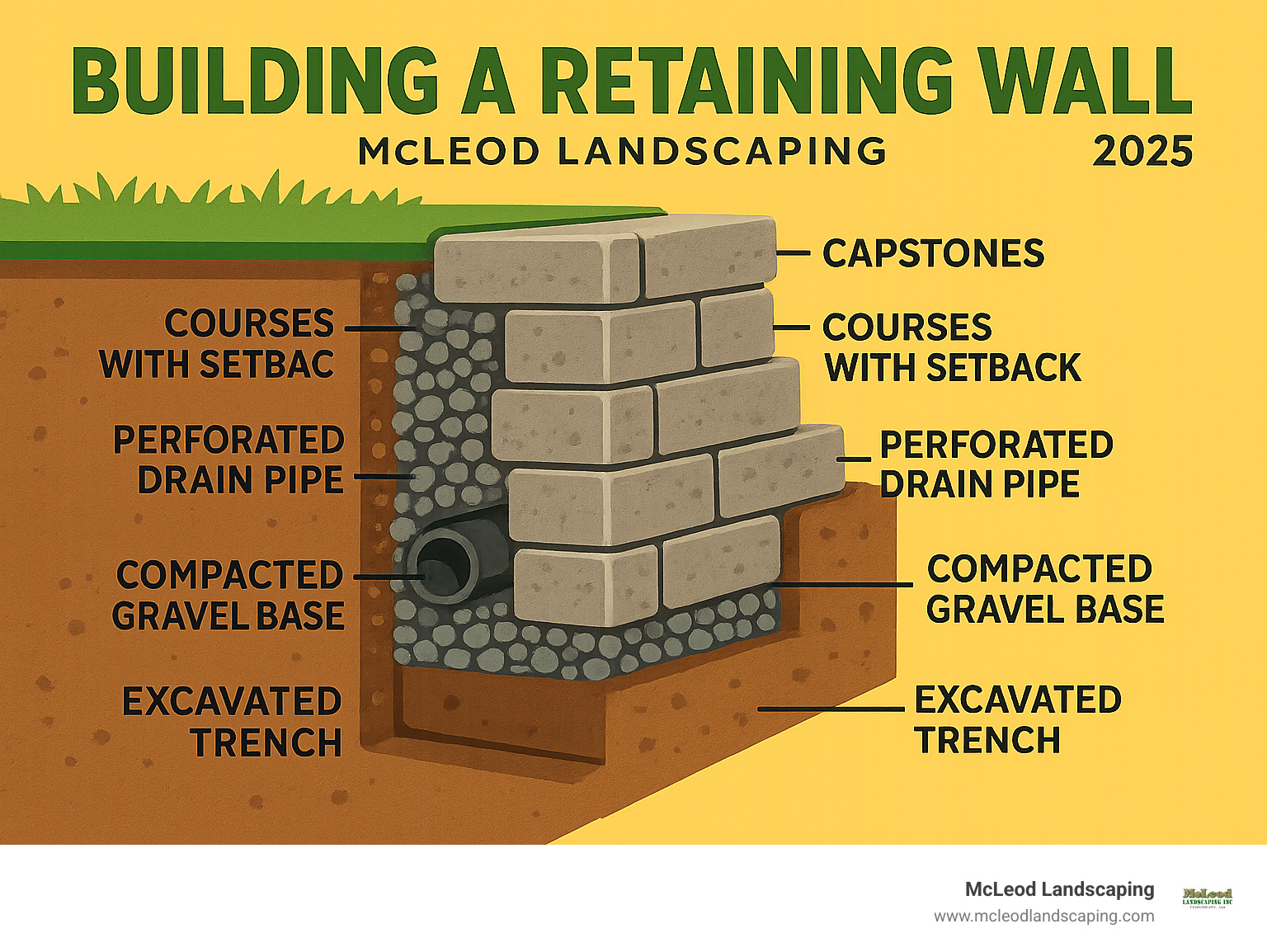
Building a retaining wall vocab to learn:
Success in building a retaining wall starts long before you pick up a shovel. Think of this planning phase as laying the groundwork for a project that could last decades – because when done right, that’s exactly what you’ll get.

Understanding the Forces at Work
Before we dive into design considerations, let’s talk about what your retaining wall will actually be fighting against. Soil isn’t just dirt – it’s incredibly heavy, especially when saturated with water. We’re talking about over 100 pounds per cubic foot of wet soil.
To put this in perspective, a modest 4-foot tall, 15-foot long retaining wall could be holding back as much as 20 tons of saturated soil. That’s like trying to hold back several elephants with a fence! This is why proper planning isn’t just helpful – it’s absolutely critical.
Wall Height: Your First Major Decision
The height of your wall determines almost everything else about your project. For building a retaining wall as a DIY project, we generally recommend staying under 3 to 4 feet tall. This isn’t just about difficulty – it’s about safety and local regulations.
Once you go above 4 feet, you’re entering territory that typically requires professional engineering. The pressure increases exponentially with height, not linearly. Some communities require engineering certification for walls over just 1.6 feet, especially if there’s additional loading nearby.
Soil Type Matters More Than You Think
The type of soil behind your wall significantly impacts both your design and drainage needs. Clay soil is compact and drains poorly, but it’s less prone to erosion and shifting. Sandy soil, on the other hand, drains well but can wash away more easily.
Understanding your soil type helps us plan for proper backfill materials and drainage systems. When in doubt, a simple soil test can save you headaches down the road.
The Frost Line Factor
In areas with cold winters like here in the Merrimack Valley, the ground freezes and thaws seasonally. If your wall’s foundation isn’t below the local frost line, this freeze-thaw cycle can cause the entire structure to heave and shift.
This is why a solid foundation below the frost line is non-negotiable. It’s not just about initial stability – it’s about long-term structural integrity through years of seasonal changes.
Surcharge Loads: The Hidden Pressure
Will anything heavy be placed on top of or near your wall? A driveway, patio, or even a large shed adds what engineers call “surcharge pressure.” This additional loading can dramatically increase the forces your wall needs to withstand.
If you’re planning to park cars, place heavy equipment, or build structures near your wall, you’ll likely need professional design and engineering to ensure safety.
Navigating Local Codes and Regulations
Before breaking ground, always check with your local building department. Many communities have specific regulations regarding retaining wall height, materials, and setbacks from property lines. Permits are often required, especially for taller walls.
This isn’t just bureaucracy – these codes exist to ensure safety and prevent problems that could affect neighboring properties. In areas like Tewksbury, MA, and throughout the Merrimack Valley, local authorities can guide you through the specific requirements for your area.
The Non-Negotiable: Call 811
This cannot be stressed enough – always call 811 or your local “Call Before You Dig” service a few days before any excavation. They’ll mark the location of underground utility lines including gas, water, electric, and communication lines.
Hitting a utility line isn’t just dangerous – it can be extremely costly and potentially life-threatening. This simple call can prevent disasters and is required by law in most areas.
For more detailed guidance on design considerations, check out our comprehensive resource on Retaining Wall Design.
Having the right tools and materials ready before you start makes the difference between a smooth project and a frustrating experience. Let’s walk through what you’ll need for a successful build.
Essential Tools for the Job
Your tool collection should include a shovel for digging and moving materials, a tape measure for accurate measurements, and levels – both a 4-foot carpenter’s level for checking multiple blocks and a torpedo level for individual block alignment.
A rubber mallet is crucial for tapping blocks into place without damage, while a hand tamper compacts your base materials properly. For larger projects, consider renting a mechanical plate compactor. A wheelbarrow will save your back when transporting blocks and materials.
Don’t forget safety gear: safety glasses and work gloves protect you from debris and rough materials. You’ll also need marking paint, string line, and stakes for laying out your wall’s footprint accurately.
Choosing Your Building Materials
The heart of your project lies in selecting the right retaining wall blocks. Calculate your needs based on wall dimensions, and purchase about 10% extra to account for breakage and future repairs. Capstones provide the finished top layer that protects your wall and gives it a polished appearance.
For the foundation and drainage, you’ll need crushed stone or gravel – specifically 3/4-inch minus gravel with angular, sharp-edged particles. Avoid rounded pea gravel, as it doesn’t compact as well. Paver base creates a firm, level bed for your first course of blocks.
Drainage Components
Proper drainage requires landscape fabric (non-woven geotextile) to separate drainage gravel from soil and prevent clogging. Perforated drain pipe, often wrapped in filter fabric, collects and directs water away from your wall.
Finally, construction adhesive secures capstones and potentially the top courses of blocks for added stability.
The material you choose affects not just the appearance of your wall, but also its strength, longevity, and how easy it is to install. Let’s explore the most common options.
Interlocking Concrete Blocks are the most popular choice for DIY projects. They’re designed to fit together securely, often with built-in setback systems that create the proper backward lean. These blocks are relatively affordable, widely available, and don’t require mortar. For more information, see our guide on Concrete Retaining Wall Blocks.
Pressure-Treated Timber offers a more rustic appearance and can be easier to work with for beginners. However, timber walls have a shorter lifespan and may not be suitable for taller installations. Our Landscape Timber Retaining Wall guide covers this option in detail.
Natural Stone provides the most attractive, permanent solution but requires more skill to install properly. Stone walls can last centuries when built correctly, but they’re also the most labor-intensive option. Learn more about Boulder Retaining Wall construction.
Poured Concrete offers maximum strength and design flexibility but typically requires professional installation due to the complexity of forming and pouring.
Understanding the costs involved helps you plan realistically and avoid surprises. Several factors influence the total investment in your retaining wall project.
Cost Factors to Consider
Material costs typically represent the largest portion of your budget, varying significantly based on your chosen materials. Labor costs apply if you hire professionals, while permit fees may be required depending on your local regulations.
Don’t forget tool rental costs if you need equipment like plate compactors or cutting tools. Site complexity – factors like access difficulty, soil conditions, and drainage requirements – can also impact your budget.
Understanding Price Ranges
Please note: cost estimates are based on national averages and do not represent actual pricing for any specific company. Prices can range from $20 to over $250 per square foot depending on materials, site complexity, and location.
Simple timber walls might fall on the lower end, while natural stone or engineered concrete systems with complex drainage can reach the higher range. For detailed cost breakdowns, visit our comprehensive guide on How Much Does A Retaining Wall Cost?.
Investing in proper materials and construction techniques upfront saves money in the long run by preventing costly repairs and rebuilds.
Contact McLeod Landscaping today at (978) 640-0957 or click here to schedule a consultation for retaining wall installation. Let our experienced team design and install a functional and visually appealing retaining wall that enhances your landscape.

1881 Main St Unit 1, Tewksbury, MA 01876