
Sodding a yard is the fastest way to get a lush, green lawn. Unlike seeding, which takes months to establish, sod provides a mature lawn ready for enjoyment within weeks. The process involves removing old grass, preparing the soil, laying sod in a staggered pattern, rolling it for good soil contact, and watering immediately. Within 2-6 weeks, the roots will be established with proper care.
The key benefits of sodding include instant curb appeal, weed reduction, and erosion prevention. While seeding costs less upfront, sod eliminates the uncertainty of germination and weather damage.
Timing matters—early fall and spring offer ideal conditions with moderate temperatures and sufficient moisture. Proper soil preparation is the most labor-intensive but critical step for long-term success.
As Scott McLeod, owner of McLeod Landscaping Inc., I’ve overseen countless sodding a yard projects across the Merrimack Valley. My team has learned that meticulous preparation and immediate post-installation care are what separate successful sod installations from failed attempts.
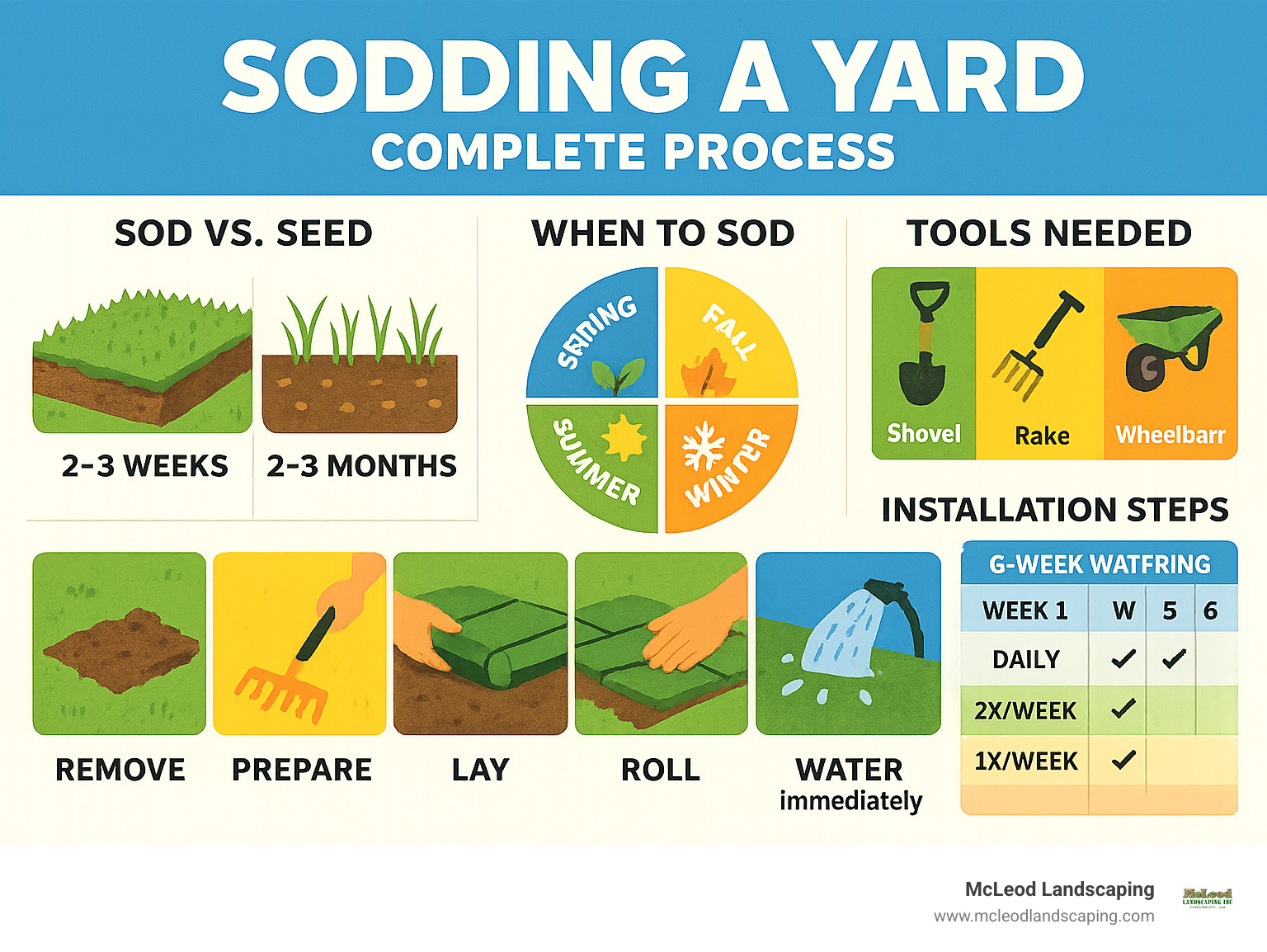
Basic sodding a yard vocab:
Successful sodding a yard begins with smart planning. Let’s walk through the key decisions that will set your project up for success.
Fall is the golden window for sodding a yard in the Merrimack Valley. September and October offer the perfect mix of cool air and warm soil, helping new sod establish strong roots before winter.
Spring is the runner-up season. Moderate temperatures and rainfall help the lawn settle in before summer’s heat. However, you’re racing to establish roots before the July sun arrives.
Avoid summer installation. I’ve seen many investments turn brown despite heavy watering. When temperatures soar, even tough sod struggles with heat stress, demanding nearly impossible amounts of moisture.
The sweet spot is 60-70 degree days, when your new sod can focus on growing roots instead of just surviving.
Understanding your yard’s conditions is crucial for picking sod that will thrive. Assess your property’s sunlight at different times of day and note foot traffic patterns.
For sunny areas, Kentucky Bluegrass offers a picture-perfect look with its rich color and fine texture. It loves full sun but requires consistent watering.
For shady spots, Fescue grass is a reliable choice. It handles both shade and drought well, making it perfect for areas under mature trees. While less vibrant than Kentucky Bluegrass, it’s far more durable.
Insider tip: most sod is grown in full sun, so even “shade-tolerant” varieties need some direct sunlight. For heavily shaded areas, consider our grass seed installation services to blend in shade-specific varieties.
Gather your arsenal before sod delivery day. Realizing you’re missing a tool while your sod bakes in the sun is a costly mistake.
Your rental list should include a sod cutter to strip old grass and a rototiller to break up compacted soil. You’ll also need a utility knife for trimming sod, a garden rake for leveling, and a lawn roller to ensure soil contact.
Don’t forget the basics: a wheelbarrow, quality sprinklers or soaker hoses, topsoil, compost, and starter fertilizer to give your new grass a nutritional boost.
Accurate measurements save money and headaches. Multiply your lawn’s length by its width for the total square footage. For precision, use a measuring wheel.
Always order 5-10% extra sod to account for cuts, odd angles, and mistakes. Running short is a major hassle.
Crucially, schedule delivery for installation day only. Fresh sod is a living plant that deteriorates quickly. A pallet weighs over a ton, so have your crew and plan ready when the truck arrives.
For professional installation techniques, check out these 14 Tips on How to Install Sod Like A Pro to help ensure your project succeeds.
With planning complete, let’s dive into the hands-on process of sodding a yard. Following these seven steps carefully will give you professional results.
To give your new sod the best start, you must create a clean slate down to bare dirt. This is the step that separates pros from amateurs.

For an existing lawn, rent a sod cutter to efficiently remove old grass and create a level surface. If you have stubborn weeds, treat them with herbicide 10-14 days prior, then remove all dead vegetation. Do not till dead weeds into the soil, as this can spread seeds. Finally, clear the area of all stones, branches, and debris. In new construction, check for hidden gravel along concrete edges that can prevent roots from establishing.
Soil preparation is the foundation of a successful lawn. Skimping on this step will cause problems for years.
First, loosen compacted soil with a rototiller to a depth of at least 6 inches (8 for heavy clay). This improves drainage and gives roots room to grow. Next, spread about 2 inches of high-quality compost over the tilled area and work it in. This improves soil structure, moisture retention, and nutrient availability. Rake the area smooth, removing any remaining debris that could create air pockets. Ensure the final grade slopes slightly away from your house for proper drainage, about 1 inch below sidewalks or sprinkler heads. Finally, apply starter fertilizer evenly with a spreader to give your new lawn the nutrients it needs.
This thoughtful approach to landscape design sets the stage for long-term success.
Now for the exciting part. Start from the area furthest from your sod pile and work backward to avoid trampling your work. Use a straight edge like a driveway or sidewalk as your guide.
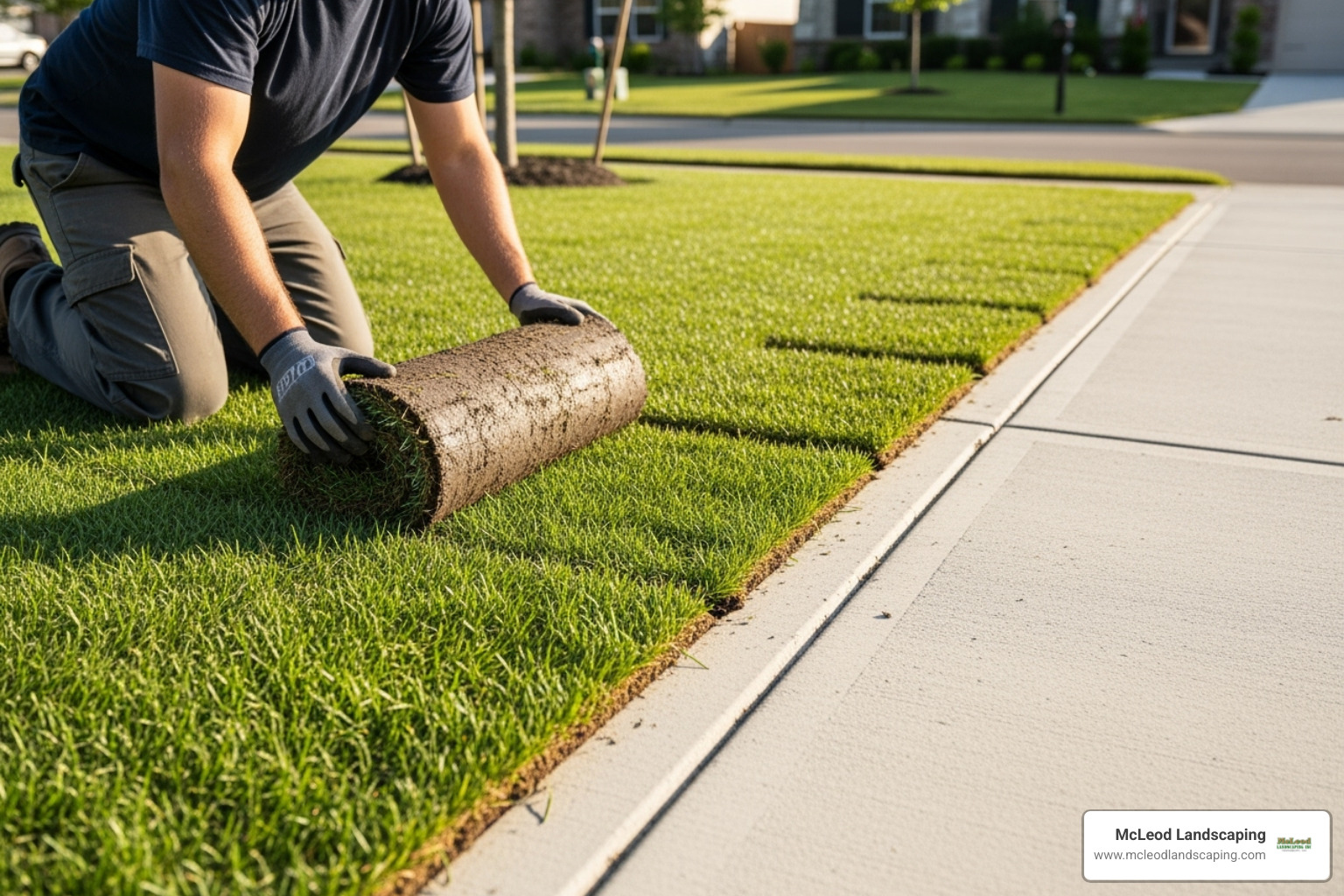
Lightly dampen the soil, then carefully unroll the first piece along your guide, ensuring full contact with the soil. Pat it down to eliminate air pockets. Avoid walking directly on new sod; use a board to distribute your weight if needed.
For a seamless look, lay sod in a brick-like pattern to stagger the seams. This prevents visible lines and helps water flow evenly. Push each piece flush against the previous one to create tight seams without overlapping. Gaps will dry out and create brown lines, while overlaps prevent proper root contact. On slopes, lay sod horizontally across the incline to prevent erosion.
You’ll need to cut sod to fit around curves and obstacles. Always cut from the soil side with a sharp utility knife for a cleaner, easier cut. For curves, lay the sod piece over the space first, then trim along your desired line. Make precise cuts for sprinkler heads and leave a few feet of space around tree trunks to protect their root systems.
Our expertise extends to comprehensive hardscape installation services that complement your new lawn.
Once all sod is laid, rolling eliminates air pockets and ensures perfect root-to-soil contact. Rent a lawn roller, fill it about 3/4 full with water, and roll the entire area twice in different directions (horizontally and vertically). This ensures every square inch gets proper contact. If heavy rain fell during installation, skip rolling to avoid shifting the sod in muddy conditions.
This final step is non-negotiable. You must water immediately after installation, ideally within 30 minutes of laying the sod. Water thoroughly until the sod and the top 1-2 inches of underlying soil are soaked. You can check by lifting a corner to see if the soil beneath is damp. This immediate watering jumpstarts the bonding process and is the difference between success and failure.
After sodding a yard, your work shifts from installation to nurturing. Your new lawn needs constant attention for the first few weeks to develop into a strong, healthy turf.
Watering is your most important task. The golden rule: never let the soil under the sod dry out during the first two weeks.
To check moisture, lift a corner of the sod. If the soil is dry, it’s time to water. Our lawn sprinkler systems can automate this crucial step.
Patience is key for the first mow. Wait at least three weeks, or until the grass is 3-4 inches tall, to allow roots to anchor. Use a lightweight push mower with sharp mower blades to avoid tearing the grass. Never cut more than one-third of the blade height, and keep the grass at least 2 inches tall.
Begin your regular fertilization program 6-8 weeks after installation. A balanced fertilizer will replenish the energy your sod used during establishment. Leaving grass clippings on the lawn acts as a free, natural fertilizer.
Keep everyone off your new lawn for the first four weeks. Heavy foot traffic can shift the sod, create gaps, and prevent proper root development. Redirect kids and pets, and use stepping stones if you must walk on the sod.
Once established, aeration and weed control become part of your long-term care. Annual aeration prevents soil compaction, and a thick, healthy lawn is the best defense against weeds and pests. This careful early care results in a lush, durable lawn that increases your property value.
Deciding whether to tackle sodding a yard yourself or hire professionals is a common dilemma. The best choice depends on your budget, time, and experience.
The cost of sodding a yard varies based on lawn size, sod type, location, site preparation, and labor. Based on internet data, the average cost of residential sod installation can range from $0.75 to $4.00 per square foot, with some complex projects potentially costing more. For example, residential sod replacement in some areas averages between $1.70 – $5.50 per square foot, while large commercial projects might start lower.
(Please note: These are average costs based on internet data and not actual costs for McLeod Landscaping. For a precise estimate for your project in the Merrimack Valley, please contact us for a consultation.)
While sodding is more expensive upfront than seeding, it offers immediate, predictable results. For a detailed price breakdown, visit our lawn installation price page.
We’ve seen many DIY sodding a yard projects go wrong. Here are common mistakes to avoid:

The decision to DIY or hire a pro for sodding a yard depends on your resources and desired outcome.
DIY Pros & Cons:
Professional Benefits:
For homeowners in Andover, Billerica, Burlington, Carlisle, Chelmsford, Concord, Lowell, Tewksbury, Westford, and Wilmington, MA, our team at McLeod Landscaping brings specialized knowledge to every project. Learn more about our residential landscaping needs.
After three decades of helping homeowners with sodding a yard, I’ve heard just about every question. Here are answers to the most common ones.
This is the most common question we get. Initial rooting happens within 2-3 weeks under ideal conditions. You’ll know it’s working when you gently lift a corner and feel resistance.
However, full establishment takes 4-6 weeks for the sod to develop a deep, strong root system that can handle normal foot traffic. The speed of rooting depends on consistent watering, moderate temperatures (60s-70s), and the quality of your soil preparation. Well-prepared, loose soil allows roots to penetrate easily.
I understand the appeal of this shortcut, but we strongly advise against laying sod over existing grass. The old grass creates a barrier, preventing new roots from making proper contact with the soil. It also competes for water and nutrients, creating an unstable surface where your new lawn can shift and fail. The extra effort of removing the old lawn and preparing the soil is essential for long-term success.
Both options create a new lawn, but they work very differently.
Sod is an instant lawn. It’s mature grass grown at a farm, harvested with soil and roots, and delivered in rolls. You get a green, lush lawn the same day.
Hydroseeding involves spraying a slurry of grass seed, mulch, fertilizer, and water over prepared soil. It’s essentially a method of seeding, not an instant lawn.
The growth time comparison is dramatic. With sodding a yard, you have an established lawn in 2-6 weeks. With hydroseeding, you’re looking at several months to achieve the same density. Sod also provides immediate weed control by crowding out weeds from day one, whereas hydroseeding offers no initial protection.
For more information on hydroseeding, visit our hydroseeding page. But for the instant gratification of a beautiful lawn, sodding a yard is the superior choice.
Congratulations! Sodding a yard delivers the incredible satisfaction of an instant change. One day you have bare dirt, and the next you have a gorgeous green lawn.
Beyond aesthetics, you’ve created instant curb appeal and made a smart financial investment, as a well-maintained lawn can increase your property value. The key to long-term success lies in the foundational steps: proper soil preparation and consistent early care. You’ve done it right from the start.
Your new sod is still establishing itself. Keep up with the watering schedule, limit foot traffic for a few weeks, and trust the process. Soon, you’ll have a thick, resilient lawn ready for your family to enjoy.
For homeowners throughout the Merrimack Valley—from Andover to Wilmington—we know how rewarding it is to admire a job well done. At McLeod Landscaping, we’ve been helping families create beautiful outdoor spaces for over three decades. Whether you tackled this sodding a yard project yourself or are considering professional help, we’re here to support your goals.
Our residential sod installation service takes the guesswork out of the process, and our hardscaping services can add the perfect finishing touches like a new walkway or patio.
Ready to transform your property with professional landscaping expertise? Contact us today for a consultation on your next project!
Contact McLeod Landscaping today at (978) 640-0957 or click here to schedule a consultation for retaining wall installation. Let our experienced team design and install a functional and visually appealing retaining wall that enhances your landscape.


1881 Main St Unit 1, Tewksbury, MA 01876